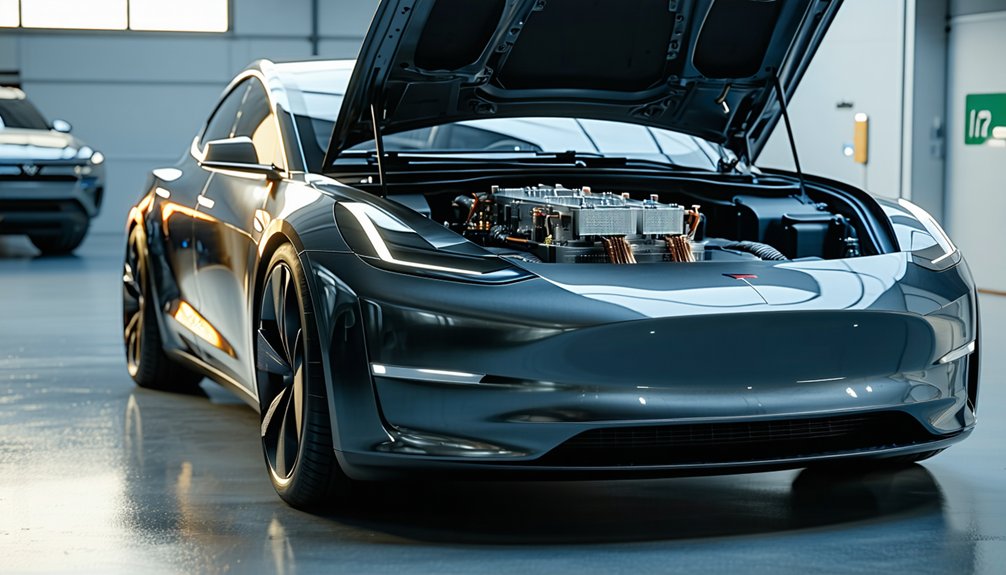
Modern battery technology prolongs vehicle lifespan through coordinated fast‑charging safeguards, precise state‑of‑charge limits, and advanced thermal management. Fast‑charging protocols now include low‑temperature heat boosts and dynamic current reduction to curb heat‑driven degradation. Keeping the pack between 20 %–80 % SOC avoids voltage extremes, while AI‑driven BMS software balances cells and predicts aging. Driving habits that minimize aggressive acceleration further reduce wear. Emerging chemistries such as LMFP and solid‑state designs promise multi‑decade durability, and deeper exploration reveals more details.
Key Takeaways
- Advanced thermal management (liquid cooling, pre‑conditioning, external station cooling) keeps pack temperature optimal, reducing heat‑induced degradation.
- Smart BMS firmware and AI‑driven SOC/SOH estimation limit charge‑discharge windows to 20‑80 % SOC, minimizing voltage stress and extending cycle life.
- Adaptive fast‑charging protocols (dynamic current reduction, low‑temperature heat boosts) lower lithium plating risk, preserving capacity during high‑power sessions.
- Emerging chemistries such as LMFP and solid‑state designs offer higher thermal stability and longer cycle counts, tolerating aggressive charging and high temperatures.
- Predictive analytics and fleet‑wide data streams enable proactive maintenance and usage‑pattern adjustments, preventing premature battery wear.
How Fast‑Charging Affects EV Battery Longevity
Often, fast‑charging is assumed to dramatically shorten EV battery life, yet real‑world data reveal a more nuanced picture. Studies of 13,000 Teslas show no significant range loss between frequent and infrequent fast‑charge users, while a Geotab analysis links high DCFC frequency (>12 % of sessions) to a modest 1 % rise in annual degradation.
Laboratory tests on Nissan Leafs indicate a 2.5 % capacity drop after 50 000 mi of Level 3 fast charging versus 1.5 % with Level 2. Chemistry matters: LFP packs tolerate aggressive charging, NMC cells stay stable below 90 % fast‑charge rates, and NCA batteries degrade exponentially with frequency. Mitigation strategies such as thermal preconditioning and partial fast charges curb heat‑driven lithium plating, allowing owners to share the benefits of rapid refueling without sacrificing longevity. Battery aging is largely driven by temperature and state‑of‑charge limits rather than charging speed alone. The study found that LFP batteries exhibit virtually no accelerated degradation even when more than 90 % of charging sessions are fast charges. High‑frequency low‑power DCFC users tend to experience lower degradation rates.
Why Keep SOC Between 20 %‑80 % for Longevity
Maintaining a state‑of‑charge (SOC) between 20 % and 80 % markedly reduces electrochemical stress, because voltage extremes that accelerate electrode wear are avoided. Within this window, voltage stress on cells drops sharply, preserving electrode integrity and extending cycle life.
Moderate SOC also sustains electrochemical balance, limiting the formation of detrimental solid‑electrolyte interphase layers. Heat generation diminishes during charging, easing thermal‑management demands and curbing temperature‑related degradation.
Empirical data show that packs kept in the 20‑80 % range retain 80‑85 % of original capacity after a decade, delivering up to 1,500 full cycles before noticeable loss. This practice aligns with community expectations for reliable, long‑lasting EV ownership while supporting the collective goal of sustainable mobility. Follow the manufacturer’s] guidance for optimal charging. Avoid frequent fast charging when the battery is warm. High‑temperature conditions further accelerate degradation, so keeping the pack cool is essential.
How Everyday Driving Habits Preserve Battery Health
By adopting smooth acceleration, steady speeds, and judicious use of regenerative braking, drivers can markedly lessen the electrochemical stress that accelerates battery wear. Smooth acceleration reduces peak current draw, preventing the rapid capacity loss associated with hard launches.
Maintaining steady cruising keeps power demand constant, which limits heat buildup and preserves electrolyte stability. Regenerative braking recovers kinetic energy, offsetting the drain caused by frequent deceleration and reducing reliance on friction brakes.
Studies show that moderate driving patterns cut annual capacity loss to roughly 1.8 %, compared with the typical 2.3 % degradation for aggressive habits. When drivers combine these practices with balanced charge cycles, the vehicle’s battery retains a higher state of health, fostering a sense of shared responsibility and long‑term confidence among the EV community. High speeds dramatically increase wind resistance, further reducing range. Using high‑power DC fast charging more than 12 % of sessions can double the degradation rate. Driving aggressive sportively can nearly double energy consumption, accelerating battery wear.
Temperature Management Tips to Extend EV Battery Life
Smooth driving habits already lessen electrochemical stress, and effective temperature management builds on that foundation by keeping the battery within its ideal thermal window. Owners should pre‑condition the pack before departure, using climate‑aware scheduling to bring the cells into the 20‑30 °C sweet spot. Battery insulation helps retain heat in cold climates, while thermal sensors continuously feed data to the vehicle’s management system, triggering liquid cooling or active air flow when temperatures approach 30 °C. During fast charging, a brief low‑temperature heat boost prevents rapid degradation, and dynamic current reduction curtails heat buildup. At public stations, external cooling units engage automatically if the pack exceeds the 35 °C limit, ensuring safe, efficient power delivery and extending overall lifespan. Pre‑arrival conditioning can be timed using predicted arrival data to reach optimal temperature before reaching the charger.
What Recent Degradation Data Say About Battery Longevity
Recent large‑scale studies reveal that EV battery capacity declines at a modest yet measurable pace, with the 2026 Geotab analysis reporting an average annual degradation of 2.3 % across 22,700 vehicles—a rise from the 1.8 % observed in 2024.
Real‑world telemetry shows fast‑charging usage pushes degradation toward 3 % per year, while moderate AC charging stays near 1.5 %. Hot climates add roughly 0.4 % annually, but charging power remains the dominant factor.
After eight years, batteries retain about 81.6 % of original capacity, projecting a lifespan exceeding 13 years before falling to 75 % capacity. Capacity forecasting models now incorporate these nuanced rates, enabling fleet managers and owners to anticipate health trends and align maintenance with community‑driven longevity goals.
Best‑Practice Charging Strategies for Daily Drivers
Typically, daily drivers keep their electric‑vehicle batteries within a 20 %–80 % state‑of‑charge, a practice that balances convenience with longevity. Observing battery etiquette, they schedule plug timing for nightly charging, using Level 2 stations that cap the charge at 80 % to 90 % per manufacturer guidance. This partial‑cycle habit reduces stress compared with full 0‑100 % swings and avoids deep discharges below 20 %.
When temperature permits, charging occurs in cool periods or shaded parking to limit thermal strain; pre‑conditioning while plugged mitigates cold‑weather effects. For short commutes, the 20‑80 % window remains ideal, while occasional 100 % tops support long trips. Consistent adherence to these practices fosters a sense of community among EV owners and extends battery life.
Emerging Battery‑Management Software That Boosts Longevity
Emerging battery‑management software leverages AI‑driven state‑of‑charge and state‑of‑health estimation to maintain accurate range predictions as cells age, while continuously recalibrating calculations to reflect degradation. The system monitors voltage, current, temperature and cell‑specific characteristics, enabling adaptive balancing that spreads load evenly and prevents hot‑spot formation.
Firmware personalization tailors charge‑discharge limits to each vehicle’s usage pattern, reducing stress during high‑power DC fast charging and avoiding prolonged extreme SoC exposure. Predictive analytics, fed by Device.CONNECT data streams, forecast aging trajectories, supporting fleet‑wide maintenance planning and second‑life valuation.
Integrated thermal management and real‑time optimization further curb degradation, delivering consistent capacity retention and fostering a sense of confidence among owners who rely on dependable, long‑lasting electric mobility.
Future EV Battery Chemistries That Could Push Longevity Beyond 20 Years
Leveraging advances in material science, future EV battery chemistries promise lifespans that exceed two decades of daily use.
Semi‑solid designs, already deployed by NIO and SAIC, deliver over 6,000 cycles with liquid‑cooled temperature control that cuts decay by 40 %, easing battery‑decay anxiety.
All‑solid batteries from Finland’s Donut Lab reach 100,000 cycles, representing a century of use, though current manufacturing complexity limits them to premium markets; ongoing work on solid‑state scalability aims to bring this durability to mainstream vehicles.
Lithium‑iron‑phosphate (LFP) and its manganese‑enhanced variant (LMFP) combine thermal stability with higher energy density, while newer formulations prioritize recyclable electrodes.
Together, these chemistries create a roadmap for multi‑decade vehicle longevity, fostering a community of owners who feel confident in the lasting value of their electric cars.
References
- https://electricautonomy.ca/ev-supply-chain/batteries/2024-09-18/ev-batteries-longevity-geotab-data/
- https://news.stanford.edu/stories/2024/12/existing-ev-batteries-may-last-up-to-40-longer-than-expected
- https://www.geotab.com/blog/ev-battery-health/
- https://www.geotab.com/blog/ev-battery-study/
- https://www.caranddriver.com/features/a70112357/electric-car-batteries-how-long-can-they-last/
- https://www.recurrentauto.com/research/how-long-do-ev-batteries-last
- https://www.drive-electric.co.uk/news/used-ev-battery-health-study/
- https://newatlas.com/automotive/ev-study-car-batteries-longevity/
- https://www.recurrentauto.com/research/impacts-of-fast-charging
- https://epp.engineering.cmu.edu/news/2025/06/18-ev-batteries.html