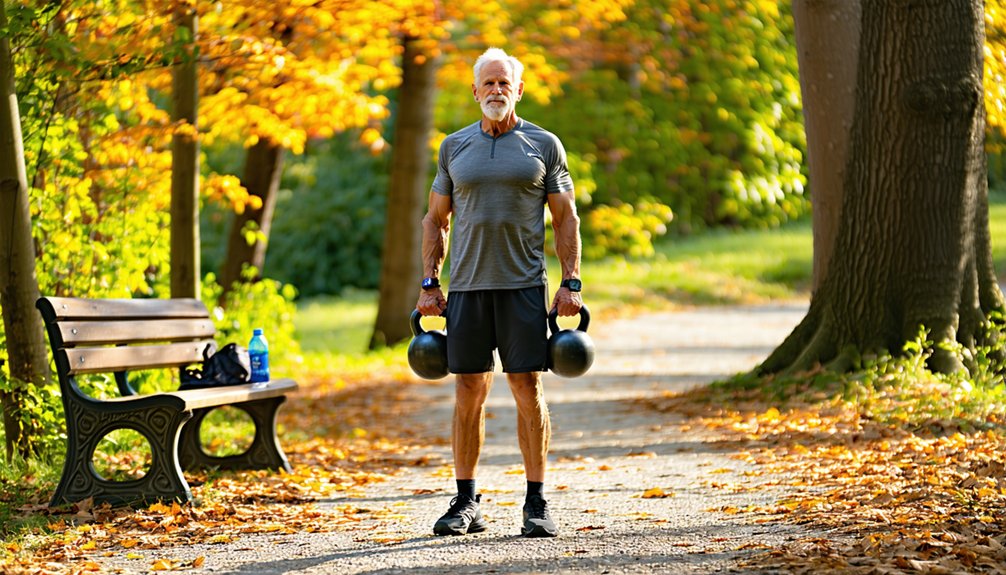
Strength training preserves bone density by stimulating osteoblast activity and remodeling the hip and spine, offsetting the 1%–3% annual loss typical after age 50. It increases muscle mass, raising resting energy expenditure and improving insulin sensitivity, which aids weight control and reduces visceral fat. Enhanced leg strength and balance lower fall risk, while regular sessions improve blood pressure, lipid profiles, and vascular function, cutting cardiovascular mortality by up to 16%. Neurotrophic benefits, longer telomeres, and slower epigenetic aging further support cognitive health, and a concise 90‑minute weekly routine can deliver these gains; the next sections detail how to build and monitor such a program.
Key Takeaways
- Improves bone density and reduces fracture risk by stimulating osteoblast activity and remodeling.
- Increases muscle mass, boosting resting metabolic rate and aiding weight management.
- Enhances balance, functional strength, and gait, cutting fall incidence by up to 50%.
- Improves cardiovascular health, lowering blood pressure, improving lipid profiles, and reducing cardiovascular mortality risk.
- Supports cognitive function and cellular aging through increased cerebral blood flow, BDNF release, and telomere preservation.
How Strength Training for Seniors Protects Bone Density After 50
Through mechanical loading, resistance training directly stimulates osteoblast activity, thereby preserving and augmenting bone mineral density (BMD) in adults over 50. The process initiates bone remodeling, where osteoblasts lay down new matrix in response to tension generated by muscle contractions during multi‑joint lifts such as squats and deadlifts.
Evidence shows that 12‑month programs in post‑menopausal women and six‑month regimens in mixed‑gender seniors yield measurable increases of 0.6 %–1.8 % in hip and spine BMD. Ideal resistance protocols prescribe 4–5 exercises, 2–3 sets of 8–12 reps at 70–90 % 1RM, three times weekly for 12–52 weeks.
Such regimens consistently offset the typical 1‑3 % annual bone loss, reducing fracture risk and fostering a shared sense of health‑focused community among older adults. Bone turnover rate declines with age, making these gains especially valuable. Adding weight‑bearing cardio such as brisk walking further enhances bone density gains. Combined frailty increases the urgency of early intervention.
Why Strength Training for Seniors Matters for Metabolism and Weight Control
The preservation of bone density through resistance‑driven mechanical loading naturally leads to a broader metabolic benefit: increased skeletal muscle mass elevates resting energy expenditure and improves glucose handling.
In seniors, each session of strength training raises the resting metabolic rate by adding metabolically active tissue that burns calories at rest and during activity. Regular bouts—two to three times weekly—drive lean muscle hypertrophy while simultaneously promoting abdominal fat loss, a key factor in maintaining healthy body composition.
Total fat mass significantly decreased across the high‑frequency training group, demonstrating the dose‑response effect of resistance training on adiposity. Enhanced insulin sensitivity further supports glucose uptake, reducing the risk of metabolic syndrome and stabilizing blood sugar.
Collectively, these physiological adaptations create a sustainable energy balance, allowing older adults to manage weight effectively while preserving functional independence. Improved bone density also contributes to overall health by reducing fracture risk. Wolff’s Law underscores how progressive loading strengthens bone and muscle.
How Strength Training for Seniors Prevents Falls and Improves Balance
Strengthening lower‑extremity muscles directly enhances balance control, reducing the incidence of injurious falls among older adults.
Evidence shows that progressive resistance training increases isometric leg extension and knee‑extensor strength, which in turn diminishes postural sway and improves Romberg performance.
Enhanced ankle stability further supports static and dynamic balance, while reaction training sharpens proactive responses measured by functional reach and reactive balance tests.
Community‑dwelling seniors who engage in multi‑component programs experience up to a 50 % decline in fall rates and fewer emergency visits.
Home‑based, video‑guided sessions three times weekly sustain gains in directional control and walking speed, fostering confidence and a sense of belonging within peer groups.
These adaptations collectively lower medically‑attended injurious falls and preserve independence.
The review found that lower‑extremity strength improvements are strongly linked to reduced fall risk.
No significant difference was observed between strength training and other exercise modalities for fall outcomes.Medication side‑effects can increase fall risk, highlighting the importance of exercise as a non‑pharmacological preventive measure.
How Strength Training for Seniors Lowers Cardiovascular Disease Risk
Improved balance and reduced fall risk are only part of the health benefits that regular resistance training offers older adults; the same muscle‑strengthening routines also provide a robust defense against cardiovascular disease. Evidence shows an 8 % lower risk of cardiovascular mortality for seniors who engage in weight training, with women achieving up to a 16 % reduction.
Peak protection occurs with 60 minutes of weekly resistance work, ideally spread over at least two sessions, and combined with aerobic activity for maximal effect. Physiologically, resistance training attenuates vascular inflammation, enhances endothelial function, and mitigates adverse cardiac remodeling.
Blood pressure, lipid profiles, and glycemic control improve concomitantly, reinforcing a thorough risk‑reduction strategy that aligns with community‑focused health goals. Moreover, a meta‑analysis of 7 cohort studies found a 17 % lower risk of cardiovascular disease among those who perform regular strength training.
How Strength Training for Seniors Boosts Cognitive Function and Brain Health
During the past decade, researchers have documented that regular resistance training markedly enhances cognitive function and brain health in older adults. Strength sessions increase cerebral blood flow and oxygen delivery, while modulating neurotransmitter activity and up‑regulating neurotrophic factors such as BDNF, which drive neuroplasticity mechanisms.
Clinical trials show improvements in orientation, language, visuospatial ability, processing speed, attention, and short‑term memory after 12 weeks of moderate‑intensity sessions (≈3 × 40 min per week). Dual tasking benefits emerge when resistance exercises are paired with concurrent cognitive challenges, producing greater attentional gains and elevated BDNF compared with strength training alone.
These findings align with international activity guidelines (≥600 MET‑min) and support a community‑focused approach to preserving mental agility and brain health in senior populations.
How Strength Training for Seniors Slows Biological Aging (Telomere & Epigenetic Data)
Promoting regular resistance training among seniors has emerged as a measurable strategy to decelerate cellular aging, as evidenced by longer telomere length and favorable epigenetic markers.
Meta‑analyses reveal that 90 minutes per week of strength work lengthens telomeres by roughly 60 base pairs, translating to an estimated 3.9‑year reduction in biological age. Dose‑response data show each additional 10 minutes adds 6.7 base pairs, while a full hour per week yields 225–238 base pairs.
Parallel epigenetic clock assessments demonstrate slowed methylation drift, indicating reduced cellular senescence.
Consistent, moderate‑intensity sessions (two to three 30‑45‑minute full‑body workouts) maintain these benefits without extreme volume, fostering a sense of collective health progress among older adults.
How to Create a 90‑Minute Weekly Strength Routine for Seniors
A 90‑minute weekly strength program for seniors can be built from two 45‑minute sessions that each target the entire musculature with five core movements—lower‑body push, lower‑body flexion, upper‑body push, upper‑body pull, and core stabilization.
Each session begins with a brief warm‑up, then proceeds through eight exercises, one set per movement, using chair exercises for safety and resistance bands for progressive load.
Typical selections include wall push‑ups, seated band rows, heel raises, seated band squats, and pelvic tilts, performed for 8‑12 controlled repetitions with a three‑second hold.
Rest days separate the sessions, allowing recovery while maintaining balance and flexibility work on non‑strength days.
This structure guarantees thorough muscle engagement, promotes independence, and fosters a supportive community of peers engaging in the same routine.
How to Track Progress and Stay Motivated for Lifelong Health
Establishing baseline measurements—daily steps, uninterrupted standing time, one‑foot balance, chair‑entry ease, and flexibility reaches—provides the reference data needed to quantify progress and sustain motivation throughout a lifelong health journey.
The individual records these metrics, then employs habit tracking through digital logs or paper calendars, noting exercise days, types, and 15‑minute duration blocks. Weekly reviews reveal adherence patterns, while bi‑weekly strength and mobility assessments—sit‑to‑stand counts, bicep curls, walking speed—capture objective gains.
Subjective wellness indicators such as breathing ease, joint stiffness, and sleep quality are logged alongside mood scales.
Reward systems reinforce consistency, celebrating milestones like extra walking time or improved balance, and community sharing via senior‑specific apps fosters belonging and sustained engagement.
References
- https://www.uclahealth.org/news/article/why-strength-training-critical-older-adults
- https://time.com/7323121/strength-training-exercises-aging-health-benefits/
- https://www.womenshealthmag.com/fitness/a69683218/strength-training-8-years-younger-study/
- https://www.nia.nih.gov/news/how-can-strength-training-build-healthier-bodies-we-age
- https://www.aarp.org/health/healthy-living/strength-training-and-longevity/
- https://pmc.ncbi.nlm.nih.gov/articles/PMC10199130/
- https://www.wnhcares.org/article/resistance-training-key-improving-bone-density-older-adults
- https://pmc.ncbi.nlm.nih.gov/articles/PMC9222380/
- https://www.orthopt.org/blog/the-role-of-strength-training-in-preventing-osteoporosis-functional-exercises-and-evidence-based-benefits
- https://pmc.ncbi.nlm.nih.gov/articles/PMC6279907/