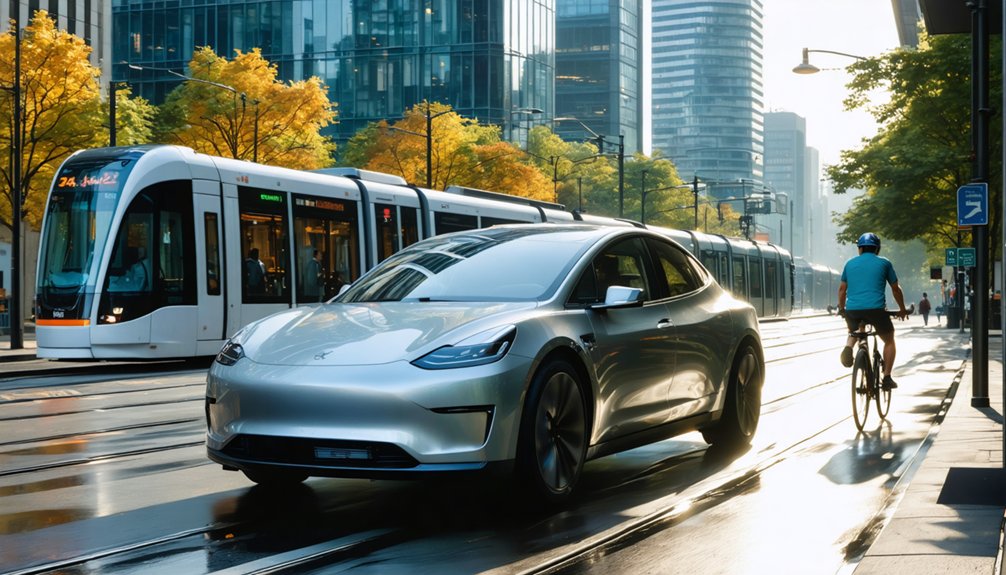
Plug‑in hybrids with a 20‑40‑mile electric‑only range and a sizable gasoline tank provide the flexibility needed for short daily commutes and occasional longer trips. Models such as the 2026 Toyota Prius Prime, Kia Niro PHEV, and Mercedes‑Benz GLC 350e balance low‑cost electric driving with range‑anxiety‑free gasoline backup. They benefit from home charging, regenerative braking, and disciplined charge etiquette to maximize fuel‑cost savings and emissions reductions. Further details reveal how to match specific commute patterns to the most suitable PHEV.
Key Takeaways
- Choose a PHEV with 40‑55 mi electric‑only range (e.g., Prius Prime, RAV4 PHEV) for most daily commutes under 40 mi, ensuring full‑electric operation.
- Prioritize models offering low nighttime electricity rates and home‑charging capability to minimize operating costs and reliance on public chargers.
- For mixed‑distance trips, select a vehicle with balanced electric range and robust total range (≈500 mi), such as the Kia Niro PHEV or Volvo XC90 T8.
- Opt for higher‑efficiency hybrids (≥40 mpg combined) like the Prius Prime or Toyota Corolla Hybrid to maximize fuel‑cost savings on longer drives.
- Consider total‑range leaders (Mercedes‑Benz S580e, Porsche Panamera Turbo S E‑Hybrid) when long‑haul flexibility and performance are priorities.
What Makes a Plug‑In Hybrid Ideal for Flexible Commuting?
With a modest electric‑only range of 20–40 miles, a plug‑in hybrid can cover most daily commutes on electricity alone, while retaining gasoline power for longer trips. Its design balances battery longevity with practical flexibility; drivers who follow charging etiquette—plugging in overnight at home and avoiding deep‑discharge cycles—preserve capacity and reduce degradation. Daily electric travel, typically 25–60 miles, meets grocery, school, or office runs, while the gasoline engine eliminates range anxiety on weekend getaways. Home charging from a standard outlet guarantees readiness without frequent stops, and lower nighttime utility rates cut operating costs. Regenerative braking further extends mileage, reinforcing the vehicle’s role as a reliable, community‑focused solution for varied commuting patterns. PHEVs typically have a small regen battery of about 1 kWh that stores energy for immediate reuse. Compact designs enable easy parking in tight city spaces. Most PHEVs do not work with public DC fast chargers which makes home charging the primary source of electricity.
How to Compare Electric‑Only Range vs. Total Gasoline Range?
The discussion now shifts to evaluating electric‑only range against total gasoline range, a distinction critical for appraising a plug‑in hybrid’s suitability across diverse travel demands.
Electric‑only range, measured by EPA testing, reflects the distance a vehicle can travel on battery power before the gasoline engine engages; typical 2026 models offer 26–53 miles, driven by 17–22 kWh packs.
Total gasoline range adds the electric miles to the fuel‑only distance calculated from tank capacity and hybrid MPG, often reaching 400–500 miles.
Buyers should prioritize electric range for commutes under 40 miles, while long‑haul drivers need robust total range.
Battery degradation and the density of charging infrastructure further influence reliance on electric‑only operation, shaping overall efficiency and cost savings.
The 2026 Mercedes‑Benz GLC 350e 4MATIC boasts the longest electric range among U.S. PHEVs, at 54 miles.
Top Three PHEVS With the Longest Overall Range (2026 Models)
Range‑leader plug‑in hybrids for 2026 combine expansive fuel tanks with sizable battery packs to achieve total distances exceeding 500 miles.
Among the long‑range contenders, the Mercedes‑Benz S580e tops the list with a 688‑mile total range, leveraging a high‑capacity battery and a premium powertrain that delivers a refined driving experience.
Close behind, the Porsche Panamera Turbo S E‑Hybrid reaches 628 miles, offering 48 miles of electric‑only travel and a 580‑mile gasoline span, positioning it as a benchmark in luxury comparisons.
The third slot is filled by the Mazda CX‑90 PHEV, which attains 536 miles through a 26‑mile EV range and 510 miles on gasoline, delivering a compelling blend of performance, efficiency, and upscale appeal for discerning commuters.
The Lexus NX450h+ provides an impressive 35 mpg fuel economy, making it a strong competitor in the efficiency segment.
Plug‑in hybrids can be charged overnight at home, reducing reliance on gas stations.
Best Fuel‑Economy PHEVs for Daily City Drives
Typically, commuters prioritize fuel‑efficiency above all, and the 2026 plug‑in hybrids that excel in city driving combine modest electric‑only ranges with strong EPA combined mileage. The Prius Prime leads with 52 mpg combined and an 80‑mile electric envelope, delivering unmatched city efficiency and a calibrated regenerative‑braking system that recovers energy on stop‑and‑go routes. The RAV4 Plug‑in Hybrid follows, offering up to 43 mpg combined and a 52‑mile electric range, while its AWD option preserves traction without sacrificing fuel economy. The NX 450h+ provides a balanced 40 mpg baseline, enhanced by a front‑wheel‑drive layout that maximizes regenerative‑braking gains. Finally, the Sportage Plug‑in Hybrid, with 42 mpg combined and a turbocharged powertrain, blends spacious practicality with efficient urban performance, reinforcing a sense of community among eco‑conscious drivers. The 2026 Kia Niro Hybrid achieves an impressive 42 mpg combined, showcasing its fuel‑efficiency advantage in the subcompact segment. The 2026 Toyota Corolla Hybrid, the most affordable on the list, offers 50 mpg combined and a low‑price entry point for budget‑focused commuters.
Pricing Tiers – Budget, Mid‑Range, and Premium Plug‑In Hybrids
Across the market, plug‑in hybrids cluster into three clear pricing tiers: budget models launch near $35,000, mid‑range offerings span $45,000‑$78,000, and premium variants exceed $70,000, often approaching six‑digit figures.
Budget choices such as the Toyota Prius Plug‑In Hybrid ($33,775) and Kia Sportage Hybrid ($31,985) deliver strong affordability analysis, with resale projections indicating modest depreciation and solid demand in the $30‑$40 k segment.
Mid‑range options, including the Toyota RAV4 Plug‑In Hybrid XSE ($50,135) and Hyundai Tucson Plug‑In Hybrid ($50,150), balance performance and cost, offering resale projections that reflect higher residual values due to broader appeal.
Premium models—BMW X5 xDrive50e, Lexus RX 450h+, and Jeep Grand Cherokee 4xe—command six‑digit pricing, and their resale projections are buoyed by brand prestige and limited competition, reinforcing an aspirational yet attainable ownership community.
Real‑World Annual Fuel Cost Savings for Each Top Model
The pricing tiers outlined earlier set the stage for quantifying how each plug‑in hybrid translates cost advantage into real‑world fuel savings. Using EPA ratings and a typical 15,000‑mile annual commute, the Toyota RAV4 PHEV yields approximately $800 annual savings, driven by its 41‑45 mpg combined rating and 50‑mile electric range.
The Mazda CX‑90 PHEV, with a 26‑mile electric envelope, delivers about $600 annual savings. Kia Sorento PHEV, averaging 35 mpg, provides $700 annual savings, while Hyundai Tucson PHEV’s 33‑38 mpg and 33‑mile electric range generate roughly $750 annual savings. Kia Sportage PHEV, at 41 mpg city and 34‑mile electric range, achieves $820 annual savings. These figures support precise commute budgeting and reinforce the sense of shared financial benefit among owners.
Environmental Impact – Emissions and Oil‑Dependence Reduction
By juxtaposing real‑world measurements with official test cycles, the analysis reveals that plug‑in hybrids emit, on average, 135 g CO₂ per kilometre—approximately 19 % less than comparable petrol or diesel vehicles, yet far above the 46 g CO₂/km reported under WLTP certification.
Real‑world data show that even in electric‑only mode, PHEVs release 68 g CO₂/km because the combustion engine assists, consuming about 3 L/100 km.
Overall fuel use averages 6.12 L/100 km, far exceeding WLTP’s 1.57 L/100 km, inflating life‑cycle emissions and diminishing the anticipated oil‑dependence reduction.
Low charging frequency further erodes benefits, causing many owners to operate vehicles like conventional hybrids.
Consequently, while PHEVs modestly improve fuel security, their net environmental impact remains close to that of traditional internal‑combustion cars.
Quick Decision Guide: Match Your Commute Pattern to the Right PHEV
Real‑world emissions data highlight that PHEVs only meet their environmental promise when driven mainly in electric mode, prompting a need to align vehicle choice with daily travel distances. For commuters under 30 miles, the 2026 Toyota Prius Plug‑In Hybrid (45 mi electric, 220 hp, $34,970) and Kia Niro PHEV (33 mi electric, $34,490) deliver full‑electric operation, fitting compact urban planning and encouraging disciplined charge etiquette.
Medium trips of 30‑50 miles favor the RAV4 PHEV (50 mi electric, 320 hp) or Volvo XC90 T8 (32‑33 mi electric, 455 hp) for balanced power and range.
Long‑distance drivers benefit from hybrid‑mode efficiency; the RAV4 PHEV, Porsche Panamera E‑Hybrid, and Mercedes‑Benz S 580e provide ample electric range plus high‑performance hybrid capability. Selecting the appropriate PHEV guarantees community cohesion, ideal energy use, and adherence to local charge etiquette.
References
- https://www.caranddriver.com/news/g46933140/plug-in-hybrids-longest-range/
- https://www.fueleconomy.gov/feg/phevtech.shtml
- https://noec.chooseev.com/compare_phev/
- https://www.motortrend.com/features/best-gas-mileage-hybrids
- https://www.consumerreports.org/cars/plug-in-hybrids/best-plug-in-hybrid-cars-and-suvs-a1332421875/
- https://www.epa.gov/fueleconomy/plug-hybrid-electric-vehicle-learn-more-about-new-label
- https://www.edmunds.com/car-news/most-fuel-efficient-hybrids-2025.html
- https://www.greencars.com/expert-insights/most-fuel-efficient-plug-in-hybrids
- https://www.caranddriver.com/features/a27127697/hybrid-vs-plug-in-hybrid/
- https://www.autoblog.com/carbuying/which-is-the-best-for-commuting-evs-phevs-hybrids-or-ices