

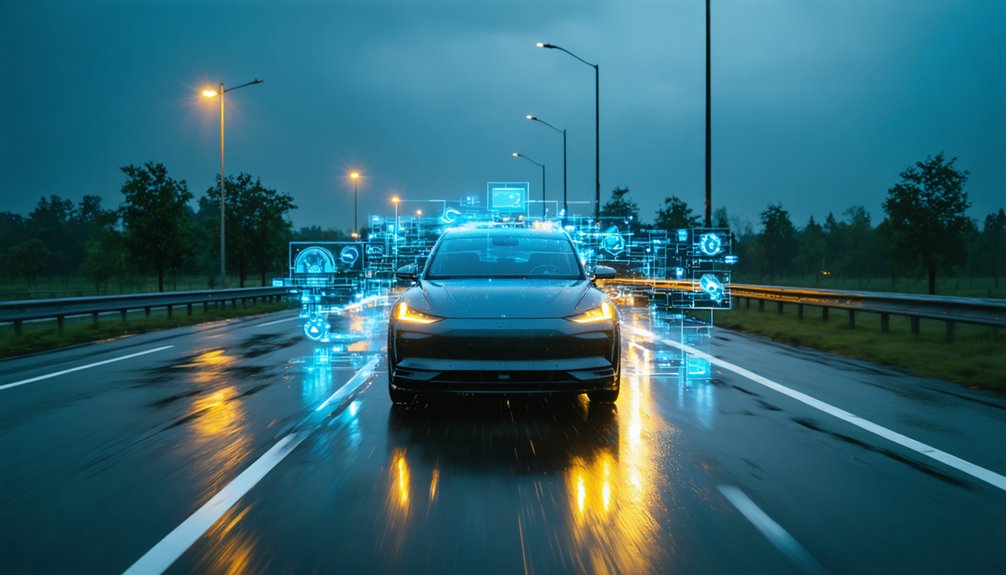

Advanced safety technologies now cut crash risk dramatically. Calibrated ADAS post‑repair restores forward‑collision warnings and emergency‑braking to factory standards, preventing silent failures. V2X communication shares real‑time hazard data, reducing vehicle‑vs‑vehicle crashes by up to 88 % in equipped corridors. AI‑powered driver monitoring detects fatigue and alcohol instantly. Sensor fusion of LiDAR, radar, and cameras enhances perception for AEB, ACC, and LDW/LKA. OTA updates keep software‑defined vehicles current, while new regulations accelerate adoption. Continued exploration reveals deeper insights.
Key Takeaways
- ADAS calibration restores factory‑level AEB and emergency‑braking, cutting crash severity and preventing silent failures.
- V2X communication shares hazard data in real time, reducing vehicle‑vs‑vehicle crashes by up to 88% after mass deployment.
- Sensor fusion of LiDAR, radar, and cameras provides robust perception, enhancing ACC, LDW/LKA, and AEB accuracy across conditions.
- AI‑driven driver monitoring detects fatigue, distraction, and impairment, lowering violation rates by 35% and improving safety outcomes.
- OTA updates and OTA‑centralized architectures enable rapid safety patches, ensuring continuous compliance and reducing recall‑related risks.
How ADAS Calibration Is Becoming a Must‑Do After Collision Repairs
Increasingly, collision repair shops confront a regulatory landscape where ADAS calibration is no longer optional but mandatory. Data show calibration inclusion rose from 0.9 % in 2017 to over 23 % by 2025, with a third of DRP appraisals now requiring it. Proper post‑repair calibration restores forward‑collision warnings and emergency‑braking to factory specifications, dramatically improving stopping margins and preventing silent failures. Workshops must adopt rigorous calibration tracking, integrate thorough owner education, and secure a clear consent process before work begins. These steps protect customers, guarantee compliance with FMVSS 127, and safeguard businesses from liability. As eight ADAS systems become standard, seamless integration of these practices is essential for safety and community trust. The rise in calibrations has driven a significant cost increase in average claim severity. Small shops often rely on outsourcing for ADAS calibrations due to limited in‑house expertise. Good calibration can restore factory‑level performance and avoid dangerous unpredictability.
Why V2X‑Enabled Sensors Are Cutting Up to 88% of Crashes
Through real‑time exchange of Basic Safety Messages and Sensor Data Sharing Messages, V2X‑enabled sensors empower vehicles to anticipate hazards long before they become imminent, delivering a projected 88 % reduction in vehicle‑vs‑vehicle crashes by the fifteenth year after mass deployment. The model relies on full vehicle connectivity, allowing each car to broadcast its intent and receive surrounding sensor data while maintaining sensor privacy through encrypted channels. By integrating Basic V2V BSMs with Collective Perception SDSMs, drivers receive early warnings that improve forward‑collision and automatic emergency‑braking performance, boosting crash‑modification factors to 0.24 and 0.55 respectively. Field tests confirm that V2X‑equipped corridors cut crash rates to 1.82 versus 3.87 on non‑equipped roads, reinforcing the technology’s role in a safer, more inclusive mobility ecosystem. Standardization challenges remain a barrier to widespread adoption. The global traffic fatality statistic underscores the urgency of deploying V2X solutions.
The Rise of AI‑Powered Driver Monitoring: Real‑Time Fatigue and Alcohol Detection
Building on V2X’s ability to pre‑empt hazards, AI‑driven driver‑monitoring systems now focus on the driver’s physiological state, delivering real‑time fatigue and alcohol detection. The market, valued at $5.2 billion in 2025, is projected to reach $5.7 billion in 2026 and $12.4 billion by 2036, growing at 8.1 % CAGR. Camera‑based solutions, holding 48 % share, analyze eye gaze, eyelid motion, head orientation and facial cues to flag driver impairment. Full‑cabin biometrics extend monitoring to health and behavior, integrating perception, reasoning and actuation for unified alerts. EU GSR mandates and global regulations compel manufacturers to embed these systems, achieving 35 % violation reductions, 50 % safety improvements, and up to 28 % lower insurance premiums for fleets. Physics‑based synthetic data is now the primary scalable method for validating long‑tail safety‑critical scenarios. The United States market is expected to grow at an 8.4 % CAGR from 2026 to 2036. Driver behavior has been identified as the top factor in collisions, surpassing environment and mileage.
How Sensor Fusion (LiDAR, Radar, Cameras) Improves Hazard Recognition
Amid the push toward higher‑level driver assistance, sensor fusion—integrating LiDAR’s high‑resolution 3D mapping, radar’s robust long‑range detection, and cameras’ rich visual detail—creates a unified perception layer that markedly improves hazard recognition.
By combining complementary strengths, the system offsets sensor limitations such as radar’s coarse resolution and camera’s weather sensitivity, delivering a broader field of view and deeper range.
Real‑time Kalman filtering and AI‑driven data‑level fusion reduce fusion latency, enabling instantaneous object detection and tracking for Adaptive Cruise Control, Lane Departure Warning, and Automatic Emergency Braking.
The resulting resilience against individual sensor failure or attack fosters driver confidence, while market forecasts—projecting multi‑billion‑dollar growth by 2030—underscore industry commitment to safer, more connected road experiences. Asia Pacific is identified as the fastest‑growing region, driven by strong government regulations and high vehicle production. The market is expected to reach 24.48 USD Billion by 2035.
The Impact of New Regulations (NHTSA NCAP, IIHS, EU GSR2) on Safety Feature Adoption
Recent regulatory updates—NHTSA’s 2026 NCAP revisions, IIHS’s revised crash‑avoidance metrics, and the EU’s GSR2 framework—are reshaping the automotive safety landscape by mandating broader adoption of advanced driver‑assist technologies. The NHTSA changes introduce pedestrian automatic emergency braking and expand lane‑keeping, blind‑spot warning, and intervention into five‑star ratings, while IIHS tightens crash‑avoidance thresholds and EU GSR2 aligns global safety benchmarks.
Regulatory incentives, such as tax credits and market‑access advantages, encourage manufacturers to embed AEB, pedestrian‑protection engineering, and thorough ADAS suites ahead of the 2029 AEB deadline and the extended 2030 compliance timeline for small‑volume makers. These clear compliance timelines and transparent evaluation criteria foster industry cohesion, allowing consumers to identify vehicles that meet rigorous safety standards and feel confident belonging to a safer driving community.
OTA Updates and Software‑Defined Vehicles: Keeping Safety Systems Current
Regulatory pressure has accelerated the adoption of over‑the‑air (OTA) mechanisms, allowing manufacturers to keep advanced driver‑assist systems (ADAS) aligned with evolving safety standards without physical recalls. OTA updates enable software‑defined vehicles to receive continuous safety enhancements, as demonstrated by Tesla’s 2023 Full Self‑Driving upgrade and Ford’s BlueCruise refinements.
Domain‑centralized architectures provide secure provisioning and streamlined update telemetry, ensuring that AI‑driven features such as emergency braking and lane‑keeping remain reliable across fleets. Real‑time OTA patches support Level 3 autonomy in Mercedes‑Benz Drive Pilot, while edge‑computing reduces latency for critical V2X interactions.
Robust cybersecurity safeguards prevent malicious manipulation, preserving safety integrity and fostering consumer confidence in a rapidly expanding market.
Real‑World Results: AEB, ACC, LDW/LKA Performance Across Vehicle Segments
Across passenger cars, SUVs, light commercial vans and heavy‑duty trucks, real‑world data confirm that the combined deployment of autonomous emergency braking (AEB), adaptive cruise control (ACC) and lane‑departure/keeping systems (LDW/LKA) delivers measurable safety gains.
Real world effectiveness is evident: AEB cuts front‑to‑rear crashes by roughly 50 % and pedestrian incidents by 25 %, while rear AEB eliminates low‑speed lot collisions. ACC maintains safe following distances, and sensor fusion with radar and cameras, boosting driver confidence across segments.
LDW/LKA, supported by high‑resolution cameras, prevents up to 14 % of lane‑departure fatalities, especially on highways.
Segment comparisons show bundled systems achieving the greatest claim‑frequency reductions in passenger cars and SUVs, with camera‑based sensors accounting for 41.72 % of the market share, underscoring a unified safety architecture.
What the Future Holds: 5GAA Trials, Autonomous Tech, and the $150 B Active‑Safety Market by 2033
By 2026, the convergence of 5GAA trials, emerging autonomous‑driving capabilities, and a rapidly expanding active‑safety ecosystem is reshaping automotive safety economics, with projected market revenues slated to hit $150 billion by 2033.
Recent Sacramento demonstrations highlighted satellite‑enabled voice calls and real‑time road‑hazard alerts, illustrating how satellite redundancy can back‑stop terrestrial V2X links.
The C‑V2X roadmap, released in late 2024, outlines spectrum management strategies that will support Direct vehicle‑to‑vehicle services across Europe and North America beginning 2026.
Autonomous parking and cross‑border corridor tests further validate network‑based safety functions.
Together, these initiatives create a unified, standards‑driven platform that promises zero‑fatality roads while inviting manufacturers, operators, and consumers into a collaborative safety network.
References
- https://www.spglobal.com/automotive-insights/en/blogs/2026/01/ces-2026-spotlights-automotive-technology
- https://www.cognitivemarketresearch.com/automotive-safety-technology-market-report
- https://www.jamasoftware.com/blog/2026-predictions-for-automotive-ai-electrification-and-the-road-to-a-connected-future/
- https://www.caliber.com/insights/2026-timeline
- https://www.datainsightsmarket.com/reports/automotive-active-safety-814263
- https://www.perforce.com/blog/sca/automotive-industry-trends
- https://inspektlabs.com/blog/top-technological-trends-automotive-companies-have-to-look-out-for-in-2026/
- https://www.icautodesign.com/news/news/automotive-technology-in-2026-the-rise-of-software-defined-intelligent-vehicles
- https://www.cccis.com/news-and-insights/posts/the-current-state-of-calibrations-a-turning-point-for-collision-repair
- https://www.aftermarketmatters.com/national-news/new-research-shows-concern-for-repair-community-to-keep-pace-with-adas/