

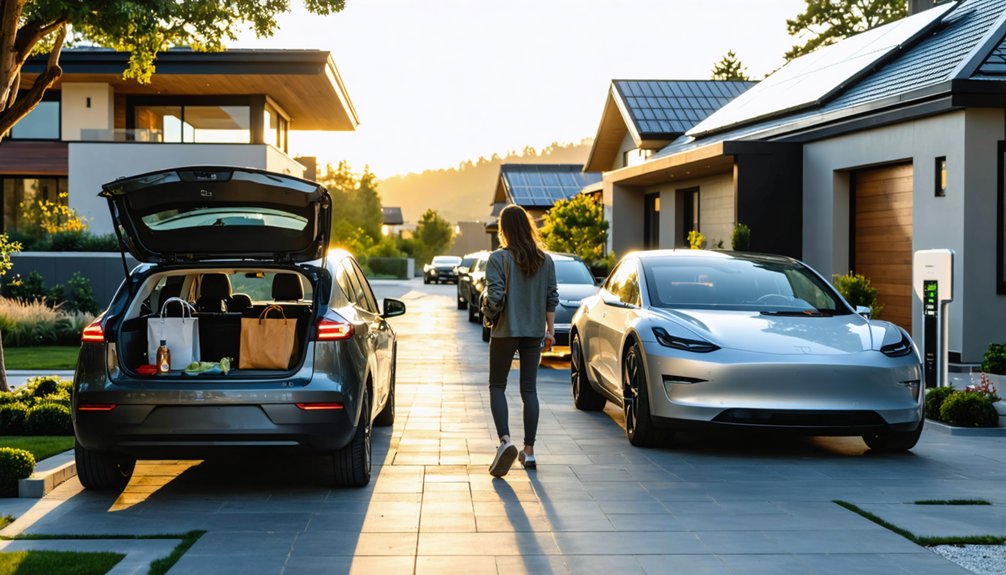

Real‑world range now exceeds WLTP by 10‑15 % in city traffic thanks to regenerative braking and stop‑start efficiency, while compact EVs regularly deliver 200‑300 miles on urban routes. Winter cuts usable range up to 30 % due to battery chemistry and HVAC loads, yet a baseline of 4‑5 mi/kWh still covers a 30‑mile round‑trip comfortably. Expanding fast‑charging networks and smart route planners lower range anxiety on long trips, and home Level‑2 chargers guarantee a full battery each morning. Continued exploration reveals how vehicle size, market trends, and driver habits further shape everyday EV use.
Key Takeaways
- Higher real‑world range, especially in city stop‑start traffic, lets drivers complete typical 30‑mi round‑trip commutes with ample buffer.
- Cold‑weather efficiency losses of up to 30 % are mitigated by larger battery packs, preserving daily usability even in winter.
- Improved efficiency (4–5 mi/kWh) reduces energy cost per mile to under $5 per 100 mi, making electric commuting cheaper than gasoline.
- Expanding fast‑charging networks and smart route planners enable longer trips without range anxiety, supporting occasional weekend travel.
- Home Level‑2 chargers provide convenient overnight charging, cutting daily planning complexity and adding resale value to homes.
How Real‑World Range Beats WLTP in City Driving
In city traffic, regenerative braking and frequent stop‑start cycles often allow electric vehicles to surpass their WLTP‑quoted range, delivering real‑world mileage that can exceed the test figure by 10‑15 percent. The synergy of regenerative efficiency and stop start optimization recovers up to 70 % of kinetic energy, extending urban range by roughly 10‑15 percent. Real‑world measurements show many models achieving 85 % of WLTP values on average, with some midsize saloons exceeding the test figure by a full 15 percent in dense traffic. Hyundai’s Ioniq 6 exemplifies this trend, while compact EVs routinely deliver 200‑300 miles in city use. Drivers experience consistent confidence, knowing that everyday commutes often outperform laboratory estimates, reinforcing a sense of community among EV owners. Winter conditions can further reduce range, but the regenerative benefits in city driving often offset this loss. The WLTP test includes four driving stages, four stages that simulate low to extra‑high speed conditions. Cold‑temperature impact can cut range by up to 30 % in extreme winter climates.
Why Winter Motorway Trips Cut Range by Up to 30
Winter motorway trips can slash an EV’s usable range by up to 30 percent, primarily because low ambient temperatures reduce battery chemistry efficiency and cabin‑heating demands draw significant power from the high‑voltage pack.
At 20 °F, HVAC use can cut range by 41 percent, while a 16 °F cruise at 70 mph depletes 25 percent of capacity.
Snow and ice increase drag, worsening cabin aerodynamics and forcing the battery to work harder to maintain speed.
Battery thermalization suffers without engine waste heat, so the pack operates below ideal temperature, further eroding efficiency.
Drivers mitigate loss by pre‑conditioning while plugged in, using heated seats instead of full cabin heaters, and removing snow to improve aerodynamics.
These practices preserve range and sustain community confidence in winter travel. Preconditioning reduces on‑road energy draw. Short trips can cause up to a 50 percent range loss. 14% reduction observed in real‑world tests highlights the importance of accurate range expectations.
What 4‑5 mi/kWh Efficiency Means for Your Daily Commute
At 4 mi/kWh, an 80 kWh battery supplies roughly 320 mi of range, comfortably covering a typical 30‑mi round‑trip commute without depleting reserves. Cold weather can reduce efficiency by up to 40 %, but the 4–5 mi/kWh baseline still leaves ample margin for daily trips. The efficiency impact reduces energy cost to about $4.30 per 100 mi, less than half the $9.14 spent on gasoline, allowing tighter commute budgeting.
Drivers of compact EVs such as the Hyundai Ioniq 6 or Tesla Model 3 experience 22‑26 kWh per 100 mi, equating to 3.8‑4.5 mi/kWh and delivering 240‑340 mi of usable range.
Consistent efficiency across varied conditions strengthens community confidence, while modest variations in style or terrain still keep daily travel well within budgeted limits, reinforcing the appeal of electric commuting. Average EV efficiency is about 3 mi/kWh, with top models reaching up to 6 mi/kWh. Midsized cars can achieve the highest efficiency levels among 2024 EVs.
How Fast‑Charging Networks Reduce Range Anxiety on Long Runs
Achieving 4–5 mi/kWh keeps daily commutes comfortably within budget, and the same efficiency gains extend to longer trips when fast‑charging infrastructure is dense enough.
In 2025 public fast chargers grew by nearly a third, pushing the U.S. total to 73,000 units and projecting 220,371 by 2033. Corridor redundancy now characterizes highway routes, where NEVI‑funded DC fast chargers meet strict uptime standards. Drivers see 80 % utilization in major markets, while ChargePoint added 190,000 ports, and Tesla operates 12,580 Supercharger ports.
The expanding network reduces range anxiety by guaranteeing at least one operational charger within a short detour, fostering confidence for long runs. As fast‑charging density climbs, the EV community experiences a shared sense of reliability and belonging on every mile. The NEVI Formula Program drives additional corridor deployments.
Choosing the Right EV Size for 200‑400 Miles of Real‑World Range
For drivers targeting a practical 200‑400 mile daily envelope, vehicle size hinges on the balance between battery capacity, efficiency, and usage patterns.
Sedan choices such as the Lucid Air Grand Touring (512 mi) and Mercedes EQS 450+ (400 mi) illustrate how larger battery packs (105–120 kWh) push the upper limit of vehicle sizing while preserving premium comfort.
Mid‑size SUVs like the BMW iX xDrive50 (380 mi) and Ford Mustang Mach‑E Extended Range (379 mi) offer comparable range with higher curb weight, demanding careful battery tradeoffs to avoid efficiency loss.
Compact options such as the Tesla Model 3 Long Range (374 mi) demonstrate that 82–97 kWh packs can meet daily needs with lighter packaging.
Selecting the right EV size thus requires matching real‑world range expectations to the vehicle’s efficiency profile and intended driving habits.
Using Smart Route Planners to Maximize Every Charge
Choosing an EV with sufficient range is only half the equation; the other half lies in how drivers navigate that range.
Smart route planners such as A Better Routeplanner, Chargeway, and Google Maps embed route optimization directly into turn‑by‑turn navigation, automatically inserting the closest, fastest chargers and calculating ETA and estimated charging time.
They draw on accurate range maps, weather and elevation data, and vehicle‑specific consumption models to avoid unnecessary detours.
By visualizing maximum driving distance and grading stations, these tools promote charging etiquette—selecting high‑power, available ports and respecting wait times.
Integrated with in‑vehicle systems from Tesla, Ford, VW, and Apple CarPlay, they reduce stress, shorten trips, and foster a community of drivers who share efficient, courteous charging habits.
How Home Level‑2 Chargers Keep Your Car Ready Every Morning
By plugging a Level‑2 charger into a home outlet, owners wake to a fully powered vehicle without the hassle of public stations. The charger’s higher voltage cuts a full charge to three to four hours, delivering overnight readiness while eliminating detours. Simplified scheduling through app‑controlled timers aligns with off‑peak rates, slashing costs up to 50 % versus public stations and avoiding costly panel upgrades.
Satisfaction scores—733 for permanent units and 714 for portable—reflect the convenience valued by 64 % of EV drivers who charge at single‑family homes. Property appeal rises, as homes with Level‑2 installations sell 13 % faster and command a resale premium. This seamless routine fosters a sense of community among EV owners who rely on dependable, at‑home power.
What the 2026 EV Market Share Means for Everyday Drivers
Amid a dip in U.S. electric‑vehicle adoption, the 2026 market share hovering around 6 % signals a quieter daily reality for drivers. Reduced tax credits and policy uncertainty have curbed sales, leaving Tesla with roughly 45 % of the pie while newer entrants like Toyota gain modest ground.
For commuters, lower sales translate into slower rotation of inventory, which can stabilize resale values as supply tightens. Yet the same uncertainty may deter first‑time buyers who fear future cost spikes or tariff impacts.
References
- https://ev-lectron.com/blogs/blog/electric-vehicle-forecast-2025-global-growth-policy-shifts-and-industry-outlook-leading-to-2026
- https://rmi.org/ev-sales-are-growing-how-do-we-keep-the-united-states-in-the-game/
- https://bridgemi.com/guest-commentary/opinion-evs-in-2026-a-reset-not-a-retreat/
- https://ev-volumes.com
- https://www.transportenvironment.org/articles/ev-progress-report-2026
- https://www.electriccarscheme.com/blog/electric-car-range
- https://caredge.com/guides/electric-vehicle-market-share-and-sales
- https://www.gridserve.com/what-is-wltp-and-how-does-it-impact-the-real-world-range-of-my-electric-car/
- https://www.edmunds.com/car-news/electric-car-range-and-consumption-epa-vs-edmunds.html
- https://www.insideevsforum.com/community/threads/what-percentage-is-real-world-of-epa-wltp-nedc.10483/