

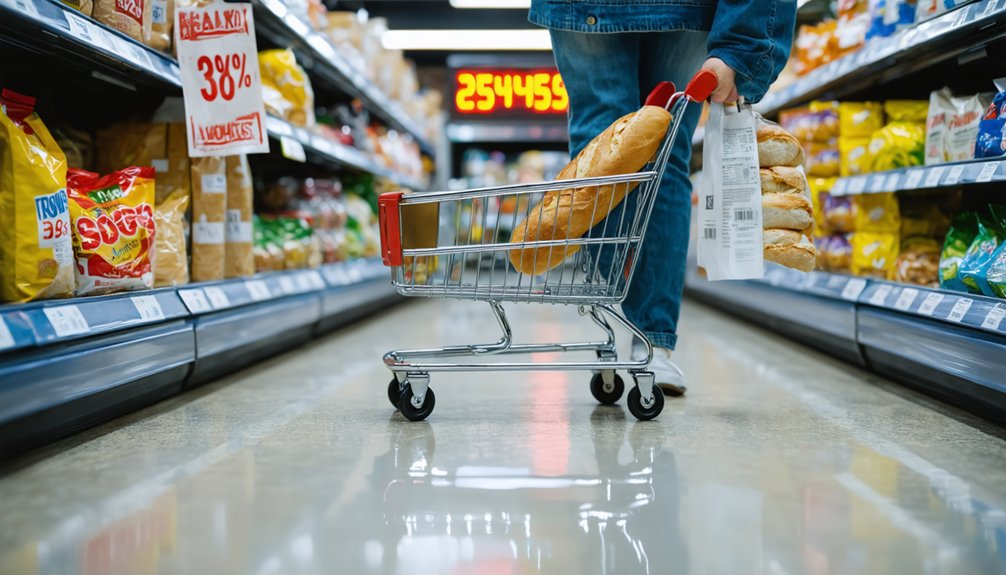

Inflation pushes food‑away‑from‑home prices up 3.7%‑4.6%, prompting households to cut dining‑out trips and rely more on home‑cooked meals. Energy bills rise, with average winter electric costs projected at $1,223, forcing tighter utility budgeting and adoption of smart thermostats. Imported‑goods price hikes add pressure to electronics and auto parts, while gendered price spikes hit women more heavily. A disciplined 4.5% saving target, zero‑based budgeting, and wage‑gain leverage can offset core pressures, and further insights await.
Key Takeaways
- Food‑away‑from‑home prices rise 3.9% YoY, adding roughly $0.80 to a $20 entrée, prompting more home‑cooked meals and portion control.
- Winter electricity bills climb 12% to $1,223 annually, driving adoption of smart thermostats and off‑peak usage to curb costs.
- Import price increases (≈1.3% YoY) and tariff passes raise consumer electronics and auto‑part costs, leading shoppers to seek discounts and delay purchases.
- Real service‑sector wages grow only 1.8% weekly, while savings rates lag at 3.5%, forcing tighter budgeting and reliance on zero‑based or envelope methods.
- Women face higher price pressures on essentials (e.g., tampons, heating), while men more often receive inflation‑adjusted salaries, widening gender wage gaps and influencing household spending allocations.
How Rising CPI Shapes Your Grocery and Meal‑Prep Choices
Steering a rising CPI compels shoppers to scrutinize every line‑item, as food‑at‑home prices are projected to climb 1.7 % in 2026—still below the 20‑year average of 2.6 % but outpaced by food‑away‑from‑home inflation of 3.7 %–4.6 %.
In response, consumers increasingly rely on meal prep to lock in costs, emphasizing precise portion sizing to stretch limited budgets.
Seasonal shopping becomes a strategic lever, as fresh vegetables and fruits rise modestly (≈1 %) while off‑season imports surge.
Effective storage techniques—vacuum sealing, proper refrigeration, and organized pantry rotation—preserve freshness and reduce waste.
Together, these practices foster a sense of community resilience, allowing households to maintain quality meals despite incremental grocery price pressures.
Egg prices are expected to significantly decline in 2026, with a projected drop of 22.2 % according to USDA ERS forecasts.
Rising energy costs could further pressure household budgets as utilities and transportation expenses increase.
average household winter electric bill is expected to reach $1,223 in 2026, a 12 % increase from 2025.
Why Cutting Dining‑Out Trips Saves More Than You Think
Amid soaring restaurant price surges—39.3 % higher than in 2019 and a 4 % year‑over‑year jump from January 2025 to January 2026—cutting dining‑out trips directly translates into measurable household savings. The 3.9 % monthly inflation on food away from home adds roughly 80 cents to a $20 entrée, which compounds to thousands when a family skips a weekly Group dining event. Skipped lunches at work further reduce discretionary outlays, reinforcing a collective habit of home‑cooked meals. Research shows 67 % of Americans already dine out less, and 85 % cite inflation as a driver, confirming that each avoided restaurant visit not only lowers the bill but also curtails the cascade of rising labor, food, and insurance costs passed to consumers. This disciplined shift strengthens household budgets and cultivates a shared sense of financial resilience. Food costs have risen 35 % over the past five years. Labor pressure remains a persistent driver of overall restaurant inflation. Lower‑income households are pulling back on dining out overall.
How Higher Energy Costs Influence Home‑Utility Budgets
Rising electricity rates are reshaping household utility budgets, as average retail prices have climbed more than 5 % since last year and surged 7 % nationally over the past twelve months, outpacing overall inflation. The average monthly bill now exceeds $144, a $23 increase from 2021, while regional spikes—such as New England’s 29.36 cents/kWH—highlight divergent affordability pressures. Households confront a $54 annual rise per 3 % price hike, and cumulative gains of 30 % since 2021 strain discretionary spending. To mitigate impact, many adopt smart thermostats and time‑of‑use programs, shifting load to off‑peak periods and curbing expenses. These tools foster collective resilience, enabling communities to share best practices while preserving comfort amid escalating energy costs. Wildfire-related costs have risen sharply, accounting for roughly two‑thirds of California’s rate increases from 2019‑2024. The EIA’s Monthly Energy Review shows that residential electricity consumption has increased by 2.5 % over the past year. Winter‑season demand spikes can double bill amounts during cold snaps.
The Hidden Impact of Imported‑Goods Inflation on Everyday Purchases
Through a steady climb in import prices—0.2 % in January, 1.3 % in February, and a 1.3 % year‑over‑year gain—the cost of everyday goods is slipping into consumers’ wallets, even as the overall inflation rate remains modest.
The rise reflects higher imported inputs for apparel, footwear, and household items, forcing retailers to embed supply chain premiums into shelf prices.
Core import prices, excluding fuels and food, rose 0.5 % in January and 1.2 % in February, amplifying pressure on low‑margin categories.
Tariff‑driven cost passes and Chinese export shifts further elevate prices for motor‑vehicle parts and consumer electronics.
As the dollar weakens, these premiums become entrenched, subtly eroding purchasing power while consumers continue to seek community‑based deals and loyalty programs to offset the hidden burden.
The trade‑weighted dollar fell 7.37 % in 2025, adding to import‑price pressures.
Budget‑Setting Strategies for a 4.5% Personal Saving Rate
Higher imported‑goods prices are squeezing household budgets, prompting many to recalibrate how they allocate every dollar. For a 4.5 % personal saving rate, experts recommend a hybrid of the 50‑30‑20 adaptation, zero‑based budgeting, and envelope system implementation.
Automatic allocations move a fixed share of after‑tax income into separate accounts for needs, discretionary spending, and a sealed savings envelope, ensuring the 4.5 % target is met before discretionary choices. Zero‑based budgeting assigns each dollar a purpose, eliminating leftovers and allowing quarterly re‑balancing.
Envelope automation—whether physical envelopes, prepaid cards, or app‑based buckets—provides visual depletion cues that reinforce discipline. Together, these tactics create a cohesive, community‑oriented framework that adapts to inflation while preserving the habit of consistent saving.
Leveraging Service‑Sector Wage Gains to Offset Core Price Pressures
By channeling the recent service‑sector wage gains into targeted budgeting strategies, households can blunt the impact of core price pressures while preserving a modest 4.5 % saving rate. Real wage growth of 1.8 %—equivalent to $23 per week—means service wages now outpace inflation by 1.7 percentage points, creating a buffer for essential expenses.
Families should allocate the incremental earnings toward high‑impact categories such as groceries and utilities, while maintaining a disciplined 4.5 % savings contribution. The sector mobility of workers between telecommunications, retail, and customer services amplifies this effect, as higher merit increases (up to 3.5 %) compound purchasing power.
Gender‑Specific Price‑Squeeze Effects and How to Respond
Why do women’s inflation expectations consistently outpace men’s, and what underlying mechanisms drive this disparity? Women’s shopping behavior, dominated by grocery purchases, exposes them to volatile price signals that amplify perceived inflation. In households where women alone handle groceries, expectations rise 0.64 percentage points; shared chores eliminate the gap. This exposure intersects with gender‑specific price squeezes—formal shoes, tampons, and heating costs—while men feel stronger impacts from fuel prices. The resulting expectations gap fuels a broader wage disparity: men are 33 % more likely to receive inflation‑adjusted salaries, leaving women vulnerable to regressive price hikes. Effective response includes equitable division of shopping duties, targeted wage advocacy, and policy pressure for gender‑responsive support, thereby narrowing expectations and mitigating disproportionate financial strain.
Planning Holiday Spending When Inflation Remains Elevated
Amid persistent price pressures, consumers must treat holiday budgeting as a strategic exercise rather than a reactive sprint. Data show a 3.9 % rise in total holiday sales, yet average selling prices climbed 7 %, so volume growth is muted.
Early budgeting becomes essential: households allocate a fixed portion of disposable income before inflation erodes purchasing power, using AI‑driven price trackers to lock in rates. Discount scouting intensifies, with 69 % of shoppers seeking deals and many favoring gifts under $100.
Black‑Friday digital spend hit $11.8 billion, up 9 %, indicating that well‑timed promotions can offset higher costs. Meanwhile, a savings rate of 3.5 % and rising BNPL usage signal financial strain, urging disciplined planning to preserve community cohesion and avoid debt escalation.
References
- https://yougov.com/en-us/articles/54197-us-consumer-spending-and-budgeting-trends-in-2026
- https://www.bls.gov/news.release/cpi.nr0.htm
- https://www.simon-kucher.com/en/insights/us-consumer-affordability-2026-insights-our-tariffs-and-price-increase-pulse-study
- https://www.upside.com/business/retailer-blog/consumer-spending-trends-2026
- https://www.pbig.ml.com/articles/2026-consumer-outlook.html
- https://markets.financialcontent.com/stocks/article/marketminute-2026-3-13-resilience-in-the-face-of-sticky-inflation-us-consumer-spending-climbs-04-as-services-costs-surge
- https://www.mckinsey.com/industries/consumer-packaged-goods/our-insights/the-state-of-the-us-consumer
- https://nielseniq.com/global/en/insights/analysis/2025/us-consumers-redefining-value-2026/
- https://www.foodnavigator-usa.com/Article/2026/02/24/2026-food-price-outlook-grocery-inflation-slows-dining-costs-up/
- https://www.bls.gov/opub/ted/2026/consumer-prices-up-2-4-percent-over-the-year-ended-january-2026.htm