

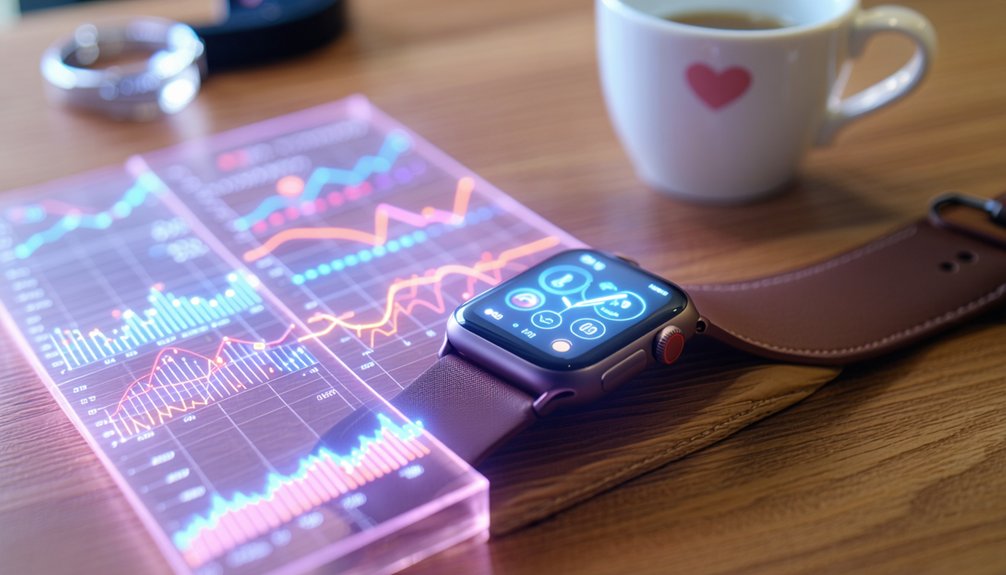

Wearable devices continuously record heart‑rate, SpO₂, motion, and sleep metrics using PPG, ECG, accelerometer, and gyroscope sensors. AI algorithms translate raw waveforms into HRV, respiratory‑rate, and temperature trends, flagging deviations that may signal stress, infection, or cardiovascular events. Integrated ECG/AF‑ alerts construct a cardiac timeline with accuracy insights, while sleep‑stage analysis derives rest‑quality scores. Data are standardized into HL7‑FHIR bundles for EHR integration, enabling longitudinal dashboards and predictive care recommendations. Further details expand on each component.
Key Takeaways
- Wearables continuously capture physiological data (HR, SpO₂, HRV, respiration) using PPG, ECG, and inertial sensors, creating high‑resolution time series.
- Algorithms compare real‑time measurements to personalized baselines, flagging deviations that indicate stress, illness, or training overload.
- Integrated cardiac timelines combine ECG‑validated events with PPG alerts, providing clinicians with sensitivity‑specific rhythm detection over days to weeks.
- Multimodal fusion of accelerometry, PPG, and temperature derives sleep‑stage and recovery metrics, enabling longitudinal assessment of rest quality.
- Cloud‑based analytics aggregate individual trends into population‑scale models, delivering early anomaly alerts and interoperable HL7‑FHIR data for EHR integration.
Capture Continuous Heart‑Rate & Spo₂ With Wearables
Capture continuous heart‑rate and SpO₂ data through wearable photoplethysmography (PPG) sensors, which emit green or infrared LEDs to monitor microvascular blood‑volume fluctuations via the wrist. These devices translate light‑absorption changes into pulse waveforms, enabling continuous SpO2 monitoring alongside heart‑rate trends. Studies show photoplethysmography accuracy peaks between 100–150 bpm, with intraclass correlation coefficients of 0.938–0.930, while mean absolute error remains under 5 bpm for most users. Integration with single‑lead ECG improves atrial‑fibrillation detection sensitivity to 91–98 %. Despite motion‑artifact challenges, compliance rates exceed 85 % and data transmission surpasses 90 %, fostering a sense of community among users who rely on reliable, long‑term health insights. Wearable devices have been shown to detect atrial fibrillation with a sensitivity of up to 95% in clinical‑grade patch studies. Accuracy declines with movement in pediatric patients. The devices showed larger errors during exercise, especially in patients with atrial fibrillation exercise‑related error.
Track Daily Activity Using Accelerometer & Gyroscope
Continuous monitoring of cardiovascular metrics naturally extends to evaluating overall movement, which relies on inertial sensors embedded in wearables. The triaxial accelerometer captures linear acceleration across three axes, enabling precise step detection and basic motion segmentation. Paired with a gyroscope that measures angular velocity, the system performs inertial calibration to correct drift and align orientation data. Sensor fusion algorithms combine these inputs, distinguishing walking from non‑step rhythms such as typing, and supporting gesture recognition for wrist‑turns or arm swings. Devices such as Apple Watch, Fitbit, and ActiGraph LEAP implement 6‑degree‑of‑freedom tracking, delivering second‑by‑second summaries that feed clinical and fitness platforms. This structured approach guarantees reliable daily activity profiling while fostering a sense of community among users who share quantified health journeys. Biocompatible sensors ensure safe skin contact for prolonged monitoring. Research‑grade sensors provide objective, quantifiable data for clinical studies. Adding an altimeter can further contextualize activity by recording elevation changes during outdoor workouts.
Generate Rest‑Quality Trends From Sleep‑Stage Sensors
When wearable sensors aggregate accelerometry, photoplethysmography, and, where available, electrocardiography, they can derive nightly rest‑quality trends that reflect shifts among wake, light sleep, deep sleep, and REM.
Multisensory patterns are extracted by fusing motion, heart‑rate variability, and pulse‑wave data, producing stage probabilities for each night. Algorithms apply immobility thresholds to mark sleep onset and offset, then compute the proportion of light, deep, and REM epochs, generating a longitudinal timeline.
Tracking nightly variability reveals gradual improvements or regressions, allowing users to compare recent weeks against baseline patterns.
Validation studies show that combined PPG + ACC models reach 72‑90 % accuracy for wake‑NREM‑REM, while ECG‑enhanced systems achieve up to 81 % accuracy, supporting reliable community‑wide health insights. EEG‑based wearables can identify all sleep stages, providing the most comprehensive stage detection capability. Consumer wearables are increasingly used in research despite limited validation. Polysomnography remains the gold standard for detailed sleep measurement.
Build a Cardiac Timeline With Ecg/Ekg, AFIB Alerts, and Accuracy Insights
By integrating ECG/EKG recordings, PPG‑derived atrial‑fibrillation (AFIB) alerts, and device‑specific accuracy metrics, a holistic cardiac timeline can be constructed that charts rhythm events, detection confidence, and measurement error over days, weeks, and months.
ECG timelines draw on on‑demand ECG confirmations, which raise sensitivity to 96.9 % and specificity to 99.3 %, while PPG‑derived AFIB alerts maintain a pooled sensitivity of 94.2 % and specificity of 95.3 %.
Accuracy insights are anchored in mean absolute errors of 4.6 bpm at rest and 13.8 bpm during peak exercise, with compliance rates exceeding 85 % and data transmission success above 90 %.
Together, these metrics enable clinicians and users to visualize cardiac health, trust detection reliability, and foster a shared sense of proactive wellness.
The study demonstrated that wearable accuracy remains high even in pediatric populations with varying activity levels.
Detect Early Illness With Ai‑Driven Trend Analysis
Leveraging continuous physiological streams from smart rings, watches, and textile sensors, AI‑driven trend analysis identifies subtle deviations that precede clinical symptom onset.
By aggregating heart‑rate, temperature, respiration, and sleep metrics, models detect immune kinetics shifts with up to 90 % accuracy, even in asymptomatic individuals.
Large‑scale population surveillance leverages two‑billion‑point datasets to establish baseline variability, enabling early identification of viral infection signatures such as those observed after flu vaccination.
Adaptive algorithms refine personal baselines, producing alerts that integrate seamlessly into community health networks.
This structured approach offers users a sense of collective safety while delivering precise, actionable insights that precede traditional symptom reporting.
Integrate Wearable Health Data Into EHR for a Unified Dashboard
Integrating wearable health data into electronic health records (EHRs) creates a unified dashboard that consolidates continuous physiological streams with clinical information, enabling clinicians to view real‑time trends alongside traditional metrics.
Standardized APIs such as Apple HealthKit and Google Fit serve as aggregation layers, translating proprietary device formats into interoperable HL7‑FHIR bundles. Epic‑ native connectors already ingest data from Fitbit, HealthKit, and Withings, demonstrating scalability across thousands of sites.
Robust data lineage records source, timestamp, and device provenance, guaranteeing trustworthiness for clinical decision‑making. Seamless workflow integration embeds alerts and risk forecasts directly into provider inboxes, aligning biometric insights with existing care pathways.
This architecture reduces silos, supports longitudinal analysis, and fosters a shared sense of participation among patients and clinicians.
Interpret Long‑Term HRV, Respiratory Rate, & Temperature Shifts
Through continuous monitoring, long‑term shifts in heart‑rate variability (HRV), respiratory rate, and skin temperature reveal nuanced physiological changes that precede clinical events.
Clinicians examine baseline shifts in HRV to differentiate stress‑induced reductions from chronic autonomic imbalance; higher HRV consistently signals robust recovery signals, while sustained declines flag overtraining or cardiovascular strain.
Respiratory rate trends are compared against personal baselines, with persistent elevations indicating infection or heightened stress, and nocturnal reductions serving as recovery signals.
Skin temperature deviations map circadian rhythm alterations and early inflammatory responses; gradual rises often precede fever.
Integrated algorithms synthesize these metrics, providing a structured, authoritative view that supports early anomaly detection, informs risk stratification, and fosters a shared sense of health stewardship among users.
Guide Personalized Lifestyle Changes With Predictive Care Insights
By translating continuous wearable data into predictive care insights, clinicians can prescribe lifestyle adjustments that preempt health deterioration. Advanced analytics extract patterns from longitudinal metrics, enabling risk stratification that isolates high‑risk individuals for targeted interventions.
Predictive algorithms generate individualized fitness plans and cardiovascular guidance, delivering behavioral nudges that align with each user’s unique physiological profile. Studies show that personalized insights double the likelihood of achieving fitness goals, while AI‑driven heart‑rate variability analysis reaches 95 % accuracy, informing preemptive activity modifications.
This data‑centric approach fosters a sense of community among health‑conscious consumers, reinforcing adherence through shared progress dashboards and collaborative goal‑setting. Ultimately, the integration of predictive care insights with tailored lifestyle recommendations cultivates sustained well‑being and reduces preventable health events.
References
- https://media.market.us/wearable-medical-devices-statistics/
- https://www.jointcorp.com/fitness-tracker-market-trends-2026-whats-next-in-wearable-health-technology/
- https://www.smartdatainc.com/knowledge-hub/why-wearable-health-tech-is-booming-in-2026/
- https://ajprotech.com/blog/internet-of-things/top-wearables-of-2026-trends-in-health-and-fitness.html
- https://clutch.co/resources/wearable-technology-trends
- https://counterpointresearch.com/en/insights/ces-2026-wearables-market-overview
- https://www.intelmarketresearch.com/smart-activity-trackers-market-33189
- https://vertu.com/guides/top-10-wearable-health-trackers-for-optimal-wellness-in-2026/
- https://healthcare-bulletin.co.uk/article/the-efficacy-of-wearable-cardiovascular-monitoring-devices-in-real-time-arrhythmia-detection-systematic-review-3415/
- https://formative.jmir.org/2025/1/e70835