

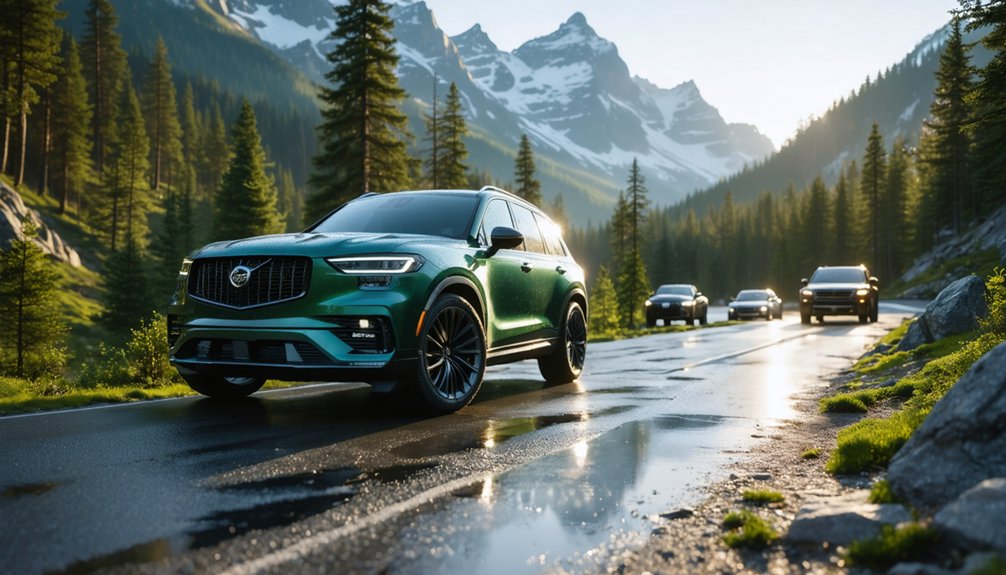

Toyota’s RAV4 and 4Runner lead the segment with reliability scores of 81/100 and 87/100, respectively, and proven powertrains that often exceed 400,000 miles. Lexus GX and RX add luxury durability, scoring above 80/100 and maintaining low repair costs. Honda CR‑V offers strong small‑SUV reliability at 84/100, while the full‑size Sequoia delivers a 44 % chance of hitting 200,000 miles. These models combine modest depreciation, predictable maintenance, and robust resale values, and further details reveal how each platform supports long‑term ownership.
Key Takeaways
- Choose body‑on‑frame models like Toyota 4Runner, Lexus GX, or Toyota Sequoia for superior durability and 7‑9 k lb towing capacity, often exceeding 200 k mi with low repair costs.
- Opt for unibody crossovers such as Toyota RAV4 Hybrid, Lexus RX Hybrid, or Mazda CX‑5 for better fuel economy (>40 mpg for RAV4 Hybrid) and smoother daily rides while still delivering reliable long‑term performance.
- Prioritize vehicles with proven, low‑depreciation platforms (e.g., Toyota 4Runner, Lexus GX, Toyota RAV4) that retain resale value and have extensive repair histories supporting 150‑200 k mi lifespans.
- Follow manufacturer maintenance schedules: oil changes every 5 k mi, tire rotations 6‑8 k mi, coolant flushes annually, and brake inspections regularly to sustain reliability.
- Use correct fluids and regular exterior care—monthly tire pressure checks, quarterly battery terminal cleaning, and annual coolant, brake, and transmission fluid monitoring—to extend component life.
Which SUVs Rank Highest on Long‑Term Reliability Scores?
Reliability scores reveal a clear hierarchy among SUVs, with midsize models dominating the top tier. Owner reviews and long‑term data show the Toyota 4Runner leading the midsize segment at 95/100 reliability, while the Lexus RX follows with low repair trends despite a modest 69/100 score.
In the small‑SUV class, the Mazda CX‑5 attains the highest rating of 84/100, and the Toyota Corolla Cross scores 79/100, both praised for consistent performance over high mileage. Luxury buyers note the Lexus GX 460’s second‑generation durability, reporting few major repairs even beyond 200,000 miles.
Across categories, high mileage owners emphasize the importance of predictable repair trends, reinforcing the perception that these models foster a reliable, belonging‑oriented community for long‑term ownership. Simple design and proven engines are key factors behind these strong reliability scores. The 2026 Mazda CX-50 also earns a solid C/D rating of 9.5/10, highlighting its durability among compact SUVs. Toyota and Lexus dominate the most reliable luxury SUV segment.
How Toyota’s Proven Platform Boosts Longevity in the RAV4 and 4Runner
Leveraging a shared engineering foundation, Toyota equips both the RAV4 and the 4Runner with powertrains that have been refined through successive generations, resulting in durability that routinely exceeds 200,000 miles with minimal intervention. The models’ shared components and modular engineering enable a bulletproof eCVT with planetary gears in the RAV4 hybrid, which regularly surpasses 400,000 miles, while the 4Runner’s fifth‑generation powertrain benefits from years of incremental refinements. Reliability scores of 81/100 for the RAV4 and 87/100 for the 4Runner underscore this longevity, despite long redesign intervals. Real‑world data show high resale values and strong sales, reinforcing the perception of belonging to a community that values proven, low‑maintenance SUVs. The platform’s consistency preserves durability across both urban and off‑road applications. The 4Runner’s off‑road hardware includes 33‑inch tires that further test its rugged engineering. The RAV4’s dominant market share in 2023 highlights consumer confidence in its long‑term reliability. The RAV4 hybrid can achieve over 40 mpg in real‑world driving, significantly outpacing the 4Runner’s fuel economy.
Why Lexus GX and RX Remain Durable Luxury Choices
Consistently, Lexus’s GX and RX maintain their reputation as durable luxury SUVs through a combination of refined powertrains, rigorous engineering standards, and sustained high reliability scores. The GX’s longevity is evident in iSeeCars data showing an average lifespan of 173,065 miles (13.8 years) and Consumer Reports 5‑star verdicts for 2021‑2022 models. Its V6 and hybrid variants consistently rank above 8/10 for reliability, value retention, and safety, while annual repair costs stay below $550. RX reliability scores remain strong, with the third‑generation (2010‑2015) achieving 93/100 from J.D. Power and the fourth generation maintaining 91/100. Even the 2026 model holds an 82/100 rating, confirming that later generations surpass earlier, issue‑prone versions. Together, these metrics reinforce a sense of belonging among owners who prioritize enduring luxury performance. The 2nd generation’s brake master cylinder recall highlights early‑generation challenges. Long‑running nameplate provides a robust data pool that underpins these reliability claims. The GX’s off‑road package further enhances its capability, offering selectable driving modes and a 360‑degree Multi‑Terrain Monitor.
What Makes the Toyota Sequoia a Reliable Full‑Size SUV?
Showcasing a blend of robust engineering and proven durability, the Toyota Sequoia consistently earns top‑tier reliability scores, including an 8.4‑out‑of‑10 rating from iSeeCars and a 4‑out‑of‑5 rating from Consumer Reports.
Its longevity is reflected in an average lifespan of 189,335 miles and a 44 % chance of reaching 200,000 miles, with well‑maintained examples surpassing 300,000 miles.
The V6 powertrain, bolstered by Toyota Safety Sense 2.5, delivers strong towing capability, routinely handling 7,000 lb to. Hybrid longevity is reinforced by an 8‑year/100,000‑mile hybrid warranty and a 10‑year/150,000‑mile battery guarantee, underscoring confidence in durability.
Consistently ranked among the most reliable large SUVs, the Sequoia offers owners a trustworthy, community‑focused choice for long‑term ownership.
Dealership Experience shows an average rating of 76/100, indicating that owners generally have a satisfactory experience with brand dealerships.
How the Honda CR‑V Stands Out Among Small SUVs
Often highlighted for its blend of durability and practicality, the Honda CR‑V distinguishes itself within the compact‑SUV segment through consistently high reliability scores—4.5 / 5.0 on RepairPal and superior projections from Consumer Reports—while delivering solid performance, spacious interior, and all‑encompassing safety technology.
Its fuel efficiency, averaging 28 mpg city and 31 mpg highway, meets the expectations of cost‑conscious owners, and the cabin quietness enhances long‑distance comfort.
Tech integration includes standard driver‑assistance systems such as automated emergency braking and lane‑keeping assist, creating a cohesive, user‑friendly environment.
The model’s resale value remains robust, supported by its reputation for durability and a strong Edmunds score of 7.5 / 10.
Collectively, these attributes affirm the CR‑V as a dependable, community‑oriented choice among small SUVs.
Comparing Ownership Costs: Maintenance, Fuel, and Depreciation
The Honda CR‑V’s reputation for reliability naturally leads to an examination of the broader cost picture that owners of comparable SUVs face, specifically maintenance expenses, fuel consumption, and depreciation.
Toyota RAV4 and Lexus NX Hybrid demonstrate low maintenance through proven platforms, while Toyota 4Runner and Lexus GX show predictable upkeep despite high mileage.
Fuel efficiency favors hybrids such as the RAV4 Hybrid and Lexus RX Hybrid, with Mazda CX‑5 and Subaru Crosstrek also delivering respectable returns.
Depreciation remains modest for Toyota Land Cruiser, Lexus GX, and 4Runner, whose resale values benefit from durability.
Owner incentives can offset initial cost, and strategic aftermarket upgrades may improve efficiency without compromising warranty, reinforcing a sense of community among long‑term SUV owners.
Choosing the Right Body‑on‑Frame vs. Unibody SUV for Your Lifestyle
Choosing between a body‑on‑frame and a unibody SUV hinges on how a driver balances off‑road capability, towing demands, and everyday efficiency.
A body‑on‑frame platform isolates the cabin from the chassis with rubber bushings, delivering superior durability for heavy loads, high ground clearance, and robust off‑road capability. It also simplifies modular repairs and supports towing capacities exceeding 9,000 lb.
In contrast, a unibody construction integrates body and frame, reducing weight and improving fuel economy, acceleration, and handling. The rigid, single‑piece design offers smoother rides, tighter turning radii, and heightened cabin refinement for daily commuting.
Buyers seeking rugged adventure and maximum hauling should favor body‑on‑frame, while those prioritizing comfort, efficiency, and refined on‑road experience will find unibody SUVs more suitable.
Tips for Maximizing the Lifespan of Your Reliable SUV
Consistently adhering to a disciplined maintenance routine is the cornerstone of extending an SUV’s useful life. Owners should follow the manufacturer’s schedule for oil changes every 5,000 miles, tire rotations at 6,000‑8,000 miles, and brake inspections, while also planning major services such as timing‑belt replacement around 100,000‑150,000 miles.
Regular servicing includes monitoring coolant, brake, power‑steering, and transmission fluids, using the correct coolant type, and performing annual coolant flushes. Tire care demands monthly pressure checks, tread‑depth inspections, and four‑wheel alignments after new tires or suspension work.
Gentle driving—slow acceleration, light braking, and cruise‑control use—reduces mechanical stress. Battery terminals should be cleaned quarterly, voltage tested semi‑annually, and the exterior washed monthly to prevent corrosion.
These practices collectively safeguard longevity and foster a sense of community among reliable‑SUV owners.
References
- https://www.autolandusa.net/blog/which-used-suvs-offer-long-term-reliability/
- https://www.youtube.com/watch?v=CJ8Oz-8nQeo
- https://www.caranddriver.com/rankings/best-suvs
- https://caredge.com/guides/the-most-reliable-suvs-and-crossovers
- https://www.consumerreports.org/cars/which-brands-make-the-best-used-cars-a2811658468/
- https://auto.howstuffworks.com/longest-lasting-suv.htm
- https://carbuzz.com/differences-rav4-vs-4runner-other-than-size/
- https://www.youtube.com/watch?v=YXhfLYBjsw0
- https://www.motorbiscuit.com/toyota-rav4-following-toyota-4runner-down-wrong-path/
- https://www.youtube.com/watch?v=tkFa6ho_w6U