

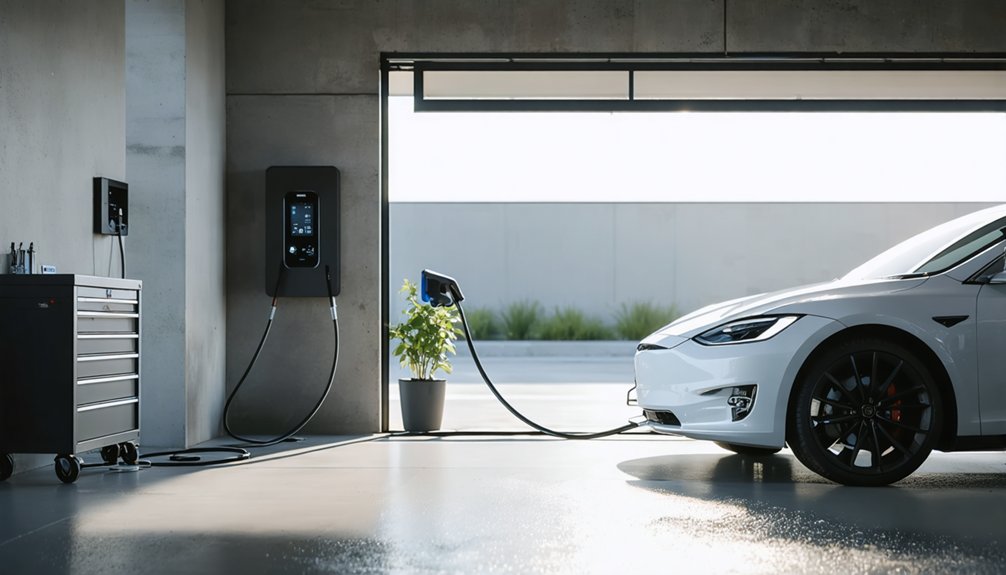

A home EV charger requires a dedicated 240‑volt circuit, adequate service capacity—often a 200‑amp panel with two empty slots—and compliance with NEC Article 625. The electrician must size the breaker at 125 % of the charger’s continuous load, typically using #8 or #6 copper conductors for runs over 100 ft, and obtain permits, inspections, and HOA approvals. Proper placement minimizes conduit length and respects ventilation. Federal tax credits and utility incentives can offset costs, and a licensed professional secures safety and code adherence, revealing further details if pursued.
Key Takeaways
- Verify your home’s electrical capacity and ensure a dedicated 240 V circuit with a breaker sized 125 % of the charger’s continuous load.
- Choose a Level‑2 charger whose amperage matches your vehicle’s onboard charger (typically 40‑50 A) and confirm connector compatibility (SAE J1772 or Tesla).
- Use appropriate conductor size (e.g., #8 AWG for up to 40 A, #6 AWG for longer runs or 50‑60 A) and install a GFCI‑protected, three‑wire circuit.
- Obtain required permits, schedule inspections, and coordinate with HOA, utility, and insurance to meet local codes and safety standards.
- Budget $1,000‑$3,500 for installation (hardware, labor, permits) and factor in potential tax credits or utility incentives to reduce net cost.
Assess Your Home’s Electrical Capacity
Evaluating a home’s electrical capacity begins with examining the service panel rating; most modern residences feature a 200‑amp panel, while older homes often operate on 100 amps or less.
A 200‑amp panel usually offers two empty slots, sufficient for a Level‑2 charger, whereas a 100‑amp system may suffice only if overall appliance demand is low.
Professionals calculate excess capacity, verify panel ventilation, and inspect historic wiring for compliance.
If the load exceeds available amperage, an upgrade is required.
The charger must connect to a dedicated 240‑volt dual‑pole circuit, sized at 125 % of the charger’s output—e.g., a 50‑amp unit needs a 70‑amp breaker.
Proper assessment guarantees safe integration and preserves communal confidence in reliable home charging. Level 2 chargers typically require a 240‑volt circuit, which can double the power draw compared to a Level 1 outlet. NEC Article 625 mandates that each charging station have a dedicated circuit.
Higher‑amp units can reduce charging time but demand appropriate wiring and breaker sizing.
Choose the Right Level‑2 Charger for Your Driving Needs
After confirming that the home’s service panel can accommodate a dedicated 240‑volt circuit, the next step is to select a Level‑2 charger that aligns with the driver’s daily mileage, vehicle’s onboard charger capacity, and desired charging speed.
Choosing the proper unit begins with amperage matching: most EVs cap at 48 A, while common residential chargers range 40–50 A, delivering 9.6–12 kW. A 7–11 kW charger typically restores 30–75 miles per hour, satisfying most daily commutes. Typical output ranges from 3 kW to 19.2 kW in the U.S., providing flexibility for different household needs.
Connector compatibility is equally critical; the SAE J1772 plug serves the majority of non‑Tesla models, whereas Tesla owners require a Tesla‑specific connector or adapter. Multi‑vehicle households benefit from chargers that support multiple standards or universal adapters, ensuring seamless, inclusive charging for every driver. Universal adapters are offered by top picks like the ChargePoint Home Flex. Fast charging can add roughly 25–40 miles of range per hour, making overnight recharges practical for most U.S. drivers.
Determine the Proper Wiring Size and Circuit Breaker Rating
Proper wiring size and circuit‑breaker rating are essential to safely deliver the amperage required by a Level‑2 EV charger.
NEC mandates breakers be sized at 125 % of the continuous load, so a 40 A charger needs at least a 50 A breaker and a 48 A charger a 60 A breaker.
Copper wire‑gauge selection follows ampacity: #10 AWG for 30 A, #8 AWG for 40 A runs under 100 ft, and #6 AWG for circuits over 100 ft or 50‑60 A loads.
Longer runs increase voltage‑drop; consequently #6 AWG is required beyond 100 ft to preserve efficiency.
Aluminum is discouraged because of thermal expansion and fire risk.
A dedicated 240 V, three‑wire (two hots and ground) circuit, GFCI protection, and professional inspection guarantee code compliance and community confidence.
Installers should verify that the equipment’s termination rating matches the selected conductor temperature.
Prewired outlets in new homes can simplify future installation and reduce overall cost.Local regulations must be consulted to ensure that cable sizing complies with regional safety standards.
Navigate Permits, Inspections, and Local Code Requirements
Having sized the wiring and breaker, the next step is to secure the required permits and understand the inspection process.
The permit process begins with a detailed application to the local building department, including site plans, electrical schematics, and contractor licensing proof.
Licensed electricians typically submit on behalf of owners, ensuring compliance with NEC and municipal codes.
Review periods range from one to four weeks for residential projects and may extend to twelve weeks for larger commercial installations.
Once work is finished, the owner must schedule inspections per the permit’s specifications; inspection timelines are dictated by the jurisdiction’s workload and the complexity of the installation.
Failure to obtain a permit or pass inspection can lead to code violations, unsafe conditions, and fines.
Plan the Charger’s Placement and Wiring Route
Choosing the charger’s location and wiring route begins with a clear assessment of the home’s electrical capacity, the proximity of the service panel, and the practical constraints of the parking space.
The installer evaluates whether the existing 200‑amp panel can support a 240‑volt, 2‑amp circuit or if an upgrade is required, then selects a spot that offers comfortable mounting height for easy cable management.
Proximity to the panel shortens conduit runs, reducing material and labor.
A direct path through walls or garage ceilings is preferred, using #6 THHN wire for a 50‑amp breaker and hard‑wiring the unit for reliability.
The power entry side dictates drilling locations, and all work must comply with NEC Article 625, ensuring proper grounding and dedicated circuit protection.
Understand the Costs and Timeline for Installation
The cost of installing a Level 2 home EV charger typically falls between $1,000 and $3,500, with a standard project averaging around $1,700; simple installations that use an existing 240 V outlet may cost as little as $300‑$800, while complex jobs requiring conduit, panel upgrades, or extensive wiring can reach $2,500‑$6,000.
Hardware ranges from $300 to $1,999, with basic units at $400‑$800 and Tesla Wall Connectors $400‑$550.
Labor for simple jobs is $800‑$1,500; complex work can exceed $3,000, especially when panel upgrades or trenching are needed.
Permitting fees add $50‑$300.
Federal tax credits and utility incentives lower net costs, and financing options such as low‑interest loans or lease‑to‑own programs make upfront expense manageable.
The installation timeline varies: straightforward installs finish in days, whereas upgrades may extend to weeks.
Hire a Licensed Electrician and What to Expect on Site
Because NEC 2026 requires a qualified licensed electrician for any residential EV‑charger installation, homeowners must engage a Journeyman or Master Electrician—often with specific EV‑SE experience—to guarantee code‑compliant wiring, proper load calculations, and necessary permitting before any work begins.
The licensed electrician will first assess panel capacity, verify that a 30‑60 amp 240‑volt circuit can be supported, and discuss any required upgrades.
Site expectations include mounting the unit at the prescribed height (18 in. indoors, 24 in. outdoors), installing a NEMA 14‑50 outlet or hard‑wire connection, and ensuring GFCI protection for wet locations.
The professional files permits, schedules inspections, and follows NEC Article 625 to secure safety and compliance, giving homeowners confidence that the installation meets all local and national standards.
Prepare for HOA, Insurance, and Utility Approvals
After securing a licensed electrician, the homeowner must address approvals from the HOA, insurance carrier, and utility provider before any work can commence.
HOA timelines require a written application, compliance with architectural and zoning rules, and a certificate of insurance naming the association as additional insured within 14 days; a denial must be issued in writing within 60 days, otherwise approval is automatic.
Insurance certificates confirm the contractor’s coverage and protect the HOA from liability, while the homeowner bears all costs and liabilities.
Utility approvals involve obtaining an electrical permit, submitting plans for review, and scheduling a post‑installation inspection to verify code compliance.
Coordinating these steps guarantees a smooth, community‑approved installation that respects legal and safety standards.
References
- https://geteco.com/blog/home-ev-charger-installation-guide/
- https://a1solarstore.com/blog/ev-charger-installation-your-complete-guide-to-home-charging-setup.html
- https://voltaelectricinc.com/blog/home-ev-charger-installation-guide-costs-process-requirements-2026/
- https://www.motortrend.com/news/nec-2026-diy-home-ev-charger-install-ban
- https://www.apexmechanicalbg.com/breaking-down-the-2026-nec-why-diy-ev-charger-installs-face-an-uncertain-future
- https://qmerit.com/blog/do-i-need-a-permit-to-install-an-ev-charger-at-home/
- https://arcon-electric.com/ev-charger-installation-florida/
- https://floridaelectricalspecialists.com/the-ultimate-guide-to-ev-charger-installation-everything-florida-homeowners-need-to-succeed/
- https://amtekconstruction.com/planning-ev-charger-installations-for-2026-what-commercial-properties-should-prepare-now/
- https://piperelectric.com/understanding-electrical-requirements-home-ev-charging/