

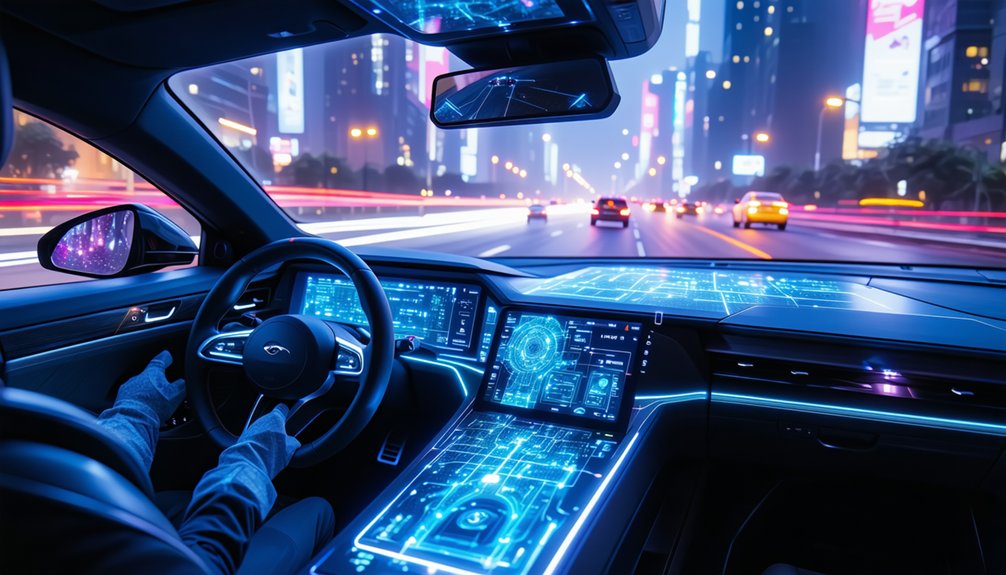

Software‑defined vehicles replace scattered ECUs with a single high‑performance processor, cutting wiring, weight, and cost while enabling rapid OTA firmware, infotainment, and safety updates. Centralized compute integrates AI and V2X radios for real‑time perception and cooperative driving, and subscription models turn pre‑installed hardware into recurring revenue. Virtual testbeds and CI/CD pipelines accelerate validation, reducing development cycles. This architecture mirrors smartphones, delivering continuous improvement and new services; the next sections explain how these benefits unfold.
Key Takeaways
- Centralized computing consolidates many ECUs into a single processor, reducing weight, wiring complexity, and manufacturing cost.
- OTA updates enable continuous feature upgrades, security patches, and performance improvements without physical service visits.
- Integrated AI and V2X capabilities provide real‑time perception, autonomous driving, and cooperative traffic intelligence.
- Subscription‑based models monetize pre‑installed hardware, creating recurring revenue streams and flexible consumer options.
- Virtual testbeds and high‑fidelity simulations accelerate development, validation, and CI/CD pipelines for rapid innovation.
How Software‑Defined Vehicles Differ From Traditional Cars
Navigate the shift from scattered electronic control units to a unified computing core. Software‑Defined Vehicles replace dozens of isolated ECUs with a single, powerful processor running a vehicle‑grade operating system.
This central platform enables modular interfaces that connect sensors, actuators, and infotainment through standardized software layers, rather than fixed wiring harnesses. Feature toggling becomes a software operation, allowing manufacturers to activate, deactivate, or upgrade functions instantly via over‑the‑air updates.
Scalable architecture consequently allows vehicle behavior to evolve after purchase, delivering personalized experiences and continuous performance improvements. The architecture mirrors modern smartphones, where hardware remains constant while the software ecosystem expands, fostering a sense of community among owners who share updates, improvements, and shared digital experiences. real‑time traffic integration further enhances safety by allowing vehicles to share road‑condition data instantly. centralized computing reduces weight and simplifies the electrical architecture, enabling faster innovation cycles.
How Centralized Computing Reduces Wiring, Weight, and Cost in Software‑Defined Vehicles
By consolidating dozens of distributed electronic control units into one or two high‑performance computers, centralized computing dramatically simplifies vehicle wiring, trims mass, and cuts cost. The architecture replaces hundreds of point‑to‑point links with a star‑network topology, enabling wiring consolidation that reduces harness complexity and material usage.
Fewer ECUs and shorter cables support weight optimization, lowering overall vehicle mass and improving fuel efficiency. A single zonal controller aggregates local sensor data, while broadband links transmit information to the central processor, eliminating redundant wiring.
Manufacturing benefits from reduced component counts, streamlined integration, and lower assembly labor. These efficiencies translate into measurable cost savings, faster production cycles, and stronger profit margins for OEMs, reinforcing a shared vision of smarter, lighter, and more affordable vehicles.
Central Computer architecture also allows for faster OTA updates across the entire vehicle, further enhancing functionality without additional wiring. The rise of electric vehicles provides a platform where software can control energy management and powertrain functions, further reducing the need for additional hardware. Software‑defined architecture enables continuous feature expansion post‑sale, aligning with emerging subscription models.
How OTA Updates Keep Software‑Defined Vehicles Continuously Improved?
Delivering software over‑the‑air (OTA) transforms software‑defined vehicles into continuously evolving platforms, allowing manufacturers to deploy firmware, infotainment, and advanced driver‑assist updates without physical service appointments. OTA leverages cellular or Wi‑Fi links to push SOTA and FOTA packages, addressing infotainment, navigation, power‑train, BMS, and ADAS logic. Real‑time usage analytics feed back performance metrics, enabling incremental security patches and predictive maintenance that reduce downtime and extend vehicle longevity. The market, valued at $4.9 billion in 2025, grows at a 19.5 % CAGR, driven by EV architectures and UNECE cybersecurity mandates. High‑profile rollouts—Volvo’s 2.5 million‑vehicle update, Tesla’s recall fix, Stellantis’s 94 million updates—demonstrate how OTA creates upgradeable digital platforms, lowers ownership costs, and fosters a sense of shared progress among owners. Industry groups such as the eSync Alliance are increasingly standardizing OTA solutions to curb costs and simplify integration. The fastest growing market is Asia‑Pacific, where a 18.92 % CAGR is propelled by the EV boom in China and India. On‑board (edge) segment dominated the market in 2024 with 63.3 % share, highlighting the importance of local processing for real‑time vehicle updates.
How AI and V2X Power Autonomous and Connected Features in Software‑Defined Vehicles?
Why do AI and V2X converge to make software‑defined vehicles truly autonomous and connected? Centralized compute platforms integrate AI and V2X radios, enabling real‑time perception, decision‑making, and cooperative driving.
Edge inference on‑device processors such as Qualcomm and Nvidia SoCs processes camera, LiDAR, and radar data within milliseconds, while V2X security protocols protect exchanged messages from spoofing and tampering.
5G‑enabled V2X links deliver high‑bandwidth, low‑latency streams that augment on‑board AI with traffic, road‑condition, and vehicle‑state information, supporting SAE Level‑3 autonomy and predictive services like charging anticipation.
Vision‑Language‑Action models fuse multimodal inputs, improving object detection and driver‑monitoring accuracy. Together, AI and V2X create a resilient, collaborative ecosystem that defines the connected, autonomous experience of software‑defined vehicles. Optical Fiber emerges as a successor to traditional Ethernet, providing the high‑speed backbone needed for centralized and zonal architectures.
What New Revenue Streams Do Subscriptions and Upgrades Open for Software‑Defined Vehicles?
AI‑enabled perception and V2X connectivity have already transformed software‑defined vehicles into platforms for continuous feature delivery, and the same architecture now underpins a suite of recurring‑revenue opportunities.
Feature subscriptions such as BMW’s heated‑seat plan ($18 / month) and Tesla’s Full‑Self‑Driving ($199 / month) illustrate how pre‑installed hardware can be monetized with zero marginal cost, generating pure profit after development amortization.
Tiered service plans—basic remote lock, premium real‑time traffic, luxury autonomous driving—mirror streaming models and have already produced billions, exemplified by GM’s OnStar $2.1 billion in 2023.
Data partnerships further expand income streams: driving‑behavior data fuels insurance pricing, advertising, and fleet‑management analytics, contributing to GM’s projected $25 billion annual software revenue by 2030.
These mechanisms collectively shift automakers from one‑time sales to sustainable, multi‑year subscription ecosystems.
How Virtualization and Simulation Accelerate Development of Software‑Defined Vehicles
By decoupling application software from hardware, virtualization enables early‑stage testing of new electrical/electronic architectures for software‑defined vehicles.
Virtual testbeds replicate entire vehicle ecosystems, providing high‑fidelity sensor models that preserve sensor fidelity for camera, lidar, and radar.
Engineers run model‑in‑the‑loop and software‑in‑the‑loop cycles within CI/CD pipelines, automating validation and catching defects before hardware prototypes exist.
This shift‑left approach compresses development from a V‑cycle to continuous testing, allowing thousands of scenarios per iteration and rapid OTA‑ready updates.
Shared platforms break silos, letting safety, sensor, and software teams collaborate on ISO 26262‑compliant campaigns.
Scalable cloud clusters and GPU‑accelerated simulations further reduce lead time, delivering a cohesive, community‑driven workflow that accelerates SDV innovation.
How Real‑World Examples Show Software‑Driven Feature Evolution
Accelerating feature evolution through software has become a defining hallmark of modern automotive strategies, as demonstrated by the deployment of over‑the‑air (OTA) updates across multiple brands.
Real‑world deployments illustrate how centralized compute platforms enable rapid rollout of new capabilities without hardware changes. BMW’s Neue Klasse leverages zonal controllers and a subscription model to add ADAS and infotainment services, while generative AI delivers in‑car assistants that learn from driver behavior.
Tesla’s FSD fleet gathers millions of miles of data, allowing fleet‑driven personalization and incremental autonomy upgrades that mimic human‑like maneuvers.
HERE’s navigation suite combines live map intelligence with e‑horizon predictions, further refining lane‑level guidance.
Chinese SDVs adopt similar OTA architectures, expanding feature‑as‑a‑service offerings and reinforcing the shift toward monetizable, upgradable vehicle experiences.
What This Shift Means for Consumers, OEMs, and the Future of Mobility?
How does the software‑defined vehicle revolution reshape the automotive ecosystem? Consumers gain continuous OTA upgrades that improve performance, safety, and infotainment, while personalization mirrors smartphones through smart cockpits and app marketplaces.
Subscription‑based ADAS and predictive‑maintenance services reduce downtime by up to 30 %, yet they raise privacy implications that demand robust data handling.
OEMs move to centralized E/E architectures, leveraging cloud‑native CI/CD pipelines to cut development cycles by 25 % and generate new revenue from feature‑on‑demand subscriptions. Zonal control and high‑performance computing enable advanced autonomy, though they require extensive user education and heightened cybersecurity.
The shift promises a more connected, efficient mobility future, aligning stakeholder interests and fostering a shared sense of technological belonging.
References
- https://www.ibm.com/think/topics/software-defined-vehicle
- https://www.ptc.com/en/blogs/alm/what-is-a-software-defined-vehicle
- https://www.sonatus.com/blog/what-is-a-software-defined-vehicle/
- https://blogs.sw.siemens.com/automotive-transportation/2025/08/22/the-complete-guide-to-software-defined-vehicles/
- https://www.valeo.com/en/everything-you-need-to-know-about-the-software-defined-vehicle-sdv/
- https://techcrunch.com/2024/01/10/wtf-is-a-software-defined-vehicle/
- https://www.bosch-mobility.com/en/mobility-topics/software-defined-vehicle/
- https://www.pwc.com/jp/en/knowledge/column/definition-of-sdv.html
- https://www.ansys.com/simulation-topics/what-is-a-software-defined-vehicle
- https://www.engineering.com/what-are-software-defined-vehicles-sdvs-and-how-are-they-different/